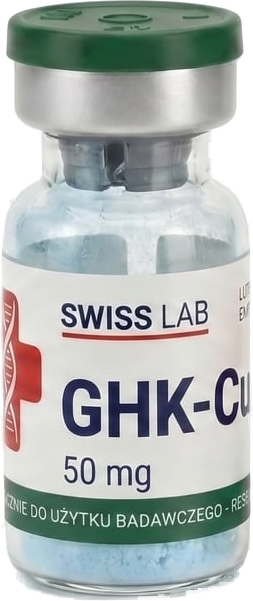
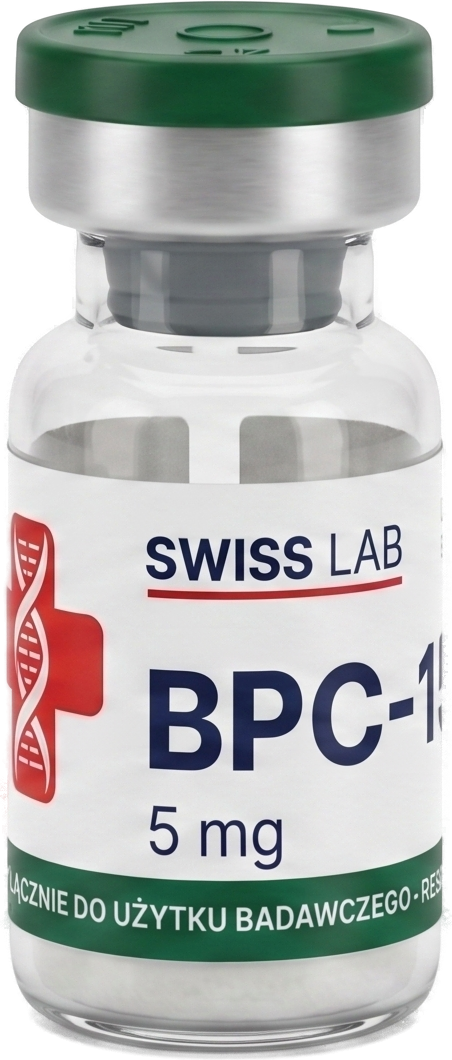
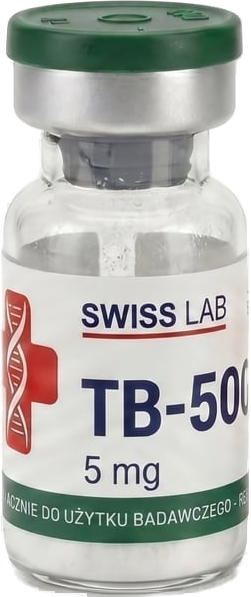
GLOW is the trade name of a blend of three research peptides: the copper tripeptide GHK-Cu, BPC-157 and TB-500. The promise behind this set is “dermal”: better skin quality and firmness, nicer healing, regeneration of soft tissues. Each component has its own literature, which we discuss in separate articles — GHK-Cu even has an unusually large one for a research peptide. This text, however, concerns the blend itself, and it has to start from a hard fact: there is no study in which these three peptides were given together — not in cells, not in animals, not in humans. The only experiment combining two of the three components (BPC-157 with TB-500, rats, 2026) showed no advantage of the pair over the single peptides. Below we explain what the blend consists of, what is known about its parts and where the evidence ends.
What GLOW is
A typical vial of GLOW contains 50 mg of GHK-Cu, 10 mg of BPC-157 and 10 mg of TB-500. That means GHK-Cu makes up about 70% of the blend's mass — which matters for the safety assessment, and we will return to it. GHK-Cu is a natural tripeptide from human plasma (glycine–histidine–lysine) bound to a copper ion; its blood concentration falls with age. BPC-157 is a synthetic peptide of fifteen amino acids modelled on a fragment of a gastric-juice protein. TB-500 is a seven-amino-acid fragment of the protein thymosin beta-4. None of the three is an approved medicine; a 2026 review stresses that all three are “not approved by the FDA or equivalent regulatory agencies” and that their use outside clinical trials “carries significant uncertainties regarding product purity, sterility, and dosing consistency” (Mavrych et al.). BPC-157 and TB-500 are, in addition, banned in sport (Mavrych et al.; Mayfield et al., 2026).
What is known about the components — in brief
GHK-Cu stimulates, in cultured skin cells, the production of collagen and other components of the tissue “scaffold”, regulates the enzymes that remodel that scaffold and influences the activity of many genes; most of the data come from the test tube and from cosmetic studies. Details are in the article GHK-Cu — the copper peptide of plasma. BPC-157 stimulates the formation of blood vessels and speeds up healing in animal models, but has no confirmed efficacy in humans — see BPC-157 — what the research really says. TB-500 reproduces the fragment of thymosin beta-4 responsible for actin binding and vessel stimulation; human studies concerned the whole protein, mainly as eye drops — see TB-500 and thymosin beta-4. The BPC-157 and TB-500 pair that forms part of GLOW is described separately in the article on the “Wolverine” blend.
The common denominator — vessels, the tissue scaffold and cells
The rationale for the blend goes: GHK-Cu “remodels” the skin, BPC-157 “delivers vascularisation”, and TB-500 “supplies repair cells”. The literature describes these three peptides differently — as compounds that largely act on the same processes. A 2026 orthopaedic review (Rahman et al.) places all three in one group of “wound-healing peptides” that “promote angiogenesis, integrin-mediated extracellular matrix remodeling, and fibroblast activation” (fibroblasts being the cells that make collagen). GHK-Cu illustrates this well: in the work of Wang et al. (2017), GHK-Cu liposomes increased the proliferation of vascular cells by 33.1%, raised their levels of the vessel growth factors VEGF and FGF-2, and in a mouse scald model improved vessel formation and shortened the healing time to 14 days. In other words, GHK-Cu also “delivers vascularisation” — just like BPC-157 and TB-500.
Why does this matter? Because three compounds acting on the same process do not have to add up. The only test of that assumption concerns two of the three components: in the study by Biçer et al. (2026) on the rat Achilles tendon, BPC-157 given together with TB-500 “did not confer additional benefits compared to either agent alone”, and the authors attribute this precisely to the two peptides converging on shared pathways. For the trio with GHK-Cu there is no such test at all.
Human data for the components
Of the three components only GHK-Cu has a controlled human study, and a particular one: it concerns a gel applied topically to wounds, not a peptide administered into the body. In a multicentre, randomised trial from 1994 (Mulder et al.), a GHK-Cu gel applied to foot ulcers in patients with diabetes — alongside standardised wound care — gave a median ulcer closure of 98.5% versus 60.8% for the peptide-free gel, and wound infections occurred in 7% of treated patients versus 34% in the control group. That is a promising result, but one from more than thirty years ago, with a single preparation and in a single indication; only in 2026 did the ClinicalTrials.gov registry record a further phase 2 trial of a GHK-Cu gel in acute skin wounds (NCT07437586). Beyond wounds, the review by Mayfield et al. (2026) states that GHK-Cu “showed promise in wound healing and anti-inflammatory effects, but no clinical data support its use for musculoskeletal conditions”. For BPC-157 and TB-500 there are no human data confirming efficacy — however extensively they have been studied in animals.
Soft-tissue regeneration and “scar quality”
Two of GLOW's promises — soft-tissue regeneration and control over scar quality — are worth confronting with the concrete data on GHK-Cu outside the skin. In the study by Fu et al. (2015), 72 rats that had undergone cruciate ligament reconstruction received GHK-Cu injections into the joint for four weeks. At six weeks the joint was more stable than in the control group, and at the lower of the two concentrations the graft was also stiffer, but by twelve weeks the differences had disappeared; nor were there differences in load to failure, in gait or in the microscopic appearance of the tissue. The authors state plainly that “the beneficial effects could not last as treatment discontinued”. For “scar quality” we found no study that assessed it after GHK-Cu, BPC-157 or TB-500 as a primary outcome; that claim rests on a mechanism (GHK-Cu regulates collagen-remodelling enzymes), not on a measured effect. And for the blend — there is nothing.
What is not known about the blend — and how we looked
A PubMed query for GHK (also as “copper peptide”) combined with BPC-157 returns seven hits, and combined with TB-500 or thymosin beta-4 — six; all of them are 2026 reviews that list these peptides side by side, and none describes a study of their blend. The name GLOW together with the component names returns not a single PubMed result. The ClinicalTrials.gov registry holds separate studies of GHK-Cu (a wound gel), BPC-157 (including a phase 2 trial in muscle strain) and TB-500 (phase 1/2, cardiovascular biomarkers), but no trial combines even two of them. The review by Mavrych et al. (2026) calls “combination therapy effects” one of the main gaps in knowledge about these peptides and adds that combining them carries “potential for unexpected interactions or cumulative toxicities”. This is not an accusation against the blend — it is a description of the state of knowledge: nothing is known about GLOW as a whole beyond what is known about its components separately.
Copper — the main safety variable
What sets GLOW apart from other blends is copper. GHK-Cu is a complex in which — as follows from the molecular masses — about 15% of the mass is the copper ion itself; a vial with 50 mg of GHK-Cu therefore contains of the order of 7–8 mg of copper. For comparison: the European Food Safety Authority concluded in 2023 that with an intake of 5 mg of copper per day “no retention of copper is expected to occur”, and set the acceptable daily intake at 0.07 mg per kilogram of body weight; it also stressed that chronic copper toxicity depends on its accumulation in the liver, which may manifest suddenly after a long time (EFSA, 2023). This comparison comes with one important caveat: the EFSA values concern copper from food. How copper from the GHK-Cu complex behaves when given by another route — and whether the other two peptides change anything about that — has not been studied. The remaining limitations are shared by all the components: no data on long-term safety in humans, the theoretical question of vessel stimulation in tumours with pro-angiogenic compounds, and unknown indications, doses and duration (Mayfield et al., 2026). We deliberately give no methods of use and no doses.
The wider context — peptide blends
GLOW is one of three blends in our encyclopaedia. The two-component BPC-157 and TB-500 pair is described in the article on the “Wolverine” blend, and the version of GLOW extended with the anti-inflammatory tripeptide KPV — in the article on the KLOW blend. All three share the same feature: the components have a literature, the blends do not. The 2026 reviews agree on this — “although preclinical studies are promising, there is a current lack of clinical trials” (Rahman et al.), and what GHK-Cu does in the test tube “remains to be established in controlled human studies” (Mavrych et al.).
Summary
GLOW combines three peptides that the literature describes as acting on the same healing processes: vessel formation, remodelling of the tissue scaffold and activation of the collagen-producing cells. The best-documented component, GHK-Cu, has one old human study with a wound gel and rich test-tube data; BPC-157 and TB-500 have almost exclusively animal data. The blend itself has been studied nowhere, and the only test of two of the three components showed no additive effect. A separate matter is copper, of which the vial contains more than the safe daily intake from food. The GLOW blend supplied by SWISS LAB is a reagent intended for research use only.
Sources
- Mulder GD, Patt LM, Sanders L, et al. Enhanced healing of ulcers in patients with diabetes by topical treatment with glycyl-l-histidyl-l-lysine copper. Wound Repair and Regeneration. 1994;2(4):259–269. PMID: 17147644. DOI: 10.1046/j.1524-475X.1994.20406.x. pubmed.ncbi.nlm.nih.gov/17147644
- Rahman OF, Lee SJ, Seeds WA. Therapeutic Peptides in Orthopaedics: Applications, Challenges, and Future Directions. JAAOS Global Research & Reviews. 2026;10(1):e25.00236. PMID: 41490200. DOI: 10.5435/JAAOSGlobal-D-25-00236. pubmed.ncbi.nlm.nih.gov/41490200
- Mayfield CK, Bolia IK, Feingold CL, et al. Injectable Peptide Therapy: A Primer for Orthopaedic and Sports Medicine Physicians. The American Journal of Sports Medicine. 2026;54(1):223–229. PMID: 41476424. DOI: 10.1177/03635465251357593. pubmed.ncbi.nlm.nih.gov/41476424
- Mavrych V, Shypilova I, Bolgova O. Therapeutic peptides in gerontology: mechanisms and applications for healthy aging. Frontiers in Aging. 2026;7:1790247. PMID: 42021992. DOI: 10.3389/fragi.2026.1790247. pubmed.ncbi.nlm.nih.gov/42021992
- EFSA Scientific Committee; More SJ, Bampidis V, et al. Re-evaluation of the existing health-based guidance values for copper and exposure assessment from all sources. EFSA Journal. 2023;21(1):e07728. PMID: 36694841. DOI: 10.2903/j.efsa.2023.7728. pubmed.ncbi.nlm.nih.gov/36694841
- Biçer O, Adanir O, Güleryüz Y, et al. Effects of BPC-157 and TB-500 on Achilles tendon healing in rats: A histopathological and biomechanical study. Joint Diseases and Related Surgery. 2026;37(3):822–837. PMID: 42542926. DOI: 10.52312/jdrs.2026.2951. pubmed.ncbi.nlm.nih.gov/42542926
- Fu SC, Cheuk YC, Chiu WY, Yung SH, Rolf CG, Chan KM. Tripeptide-copper complex GHK-Cu (II) transiently improved healing outcome in a rat model of ACL reconstruction. Journal of Orthopaedic Research. 2015;33(7):1024–1033. PMID: 25731775. DOI: 10.1002/jor.22831. pubmed.ncbi.nlm.nih.gov/25731775
- Wang X, Liu B, Xu Q, et al. GHK-Cu-liposomes accelerate scald wound healing in mice by promoting cell proliferation and angiogenesis. Wound Repair and Regeneration. 2017;25(2):270–278. PMID: 28370978. DOI: 10.1111/wrr.12520. pubmed.ncbi.nlm.nih.gov/28370978
For in-vitro laboratory research only. It is not a human medicine and is not for treatment.