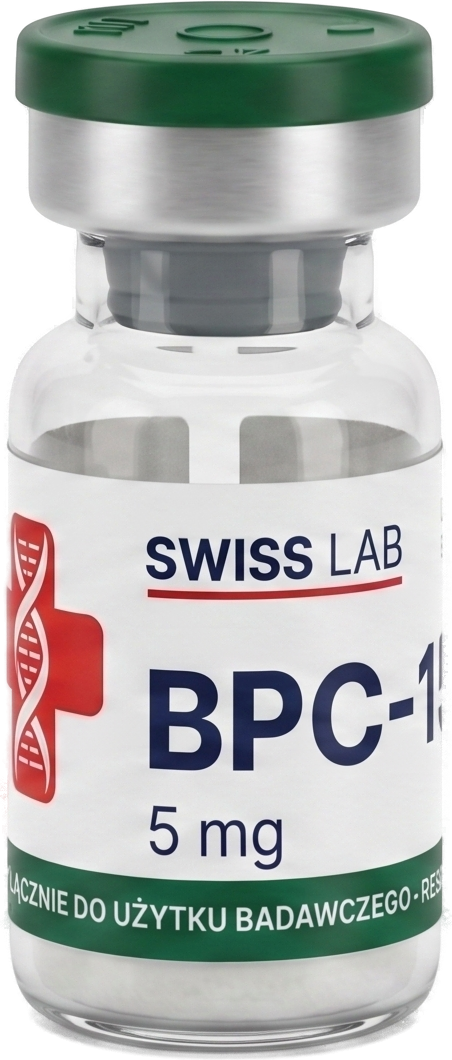
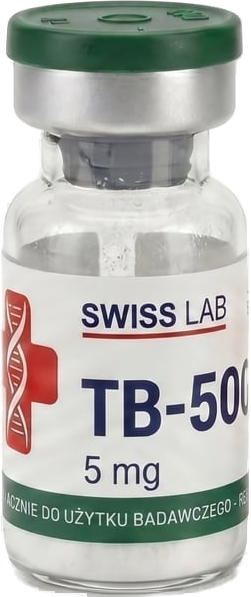
“Wolverine” is the colloquial name of a blend of two research peptides: BPC-157 and TB-500. The name comes from the comic-book character who heals almost instantly — and it captures the promise biohackers attach to this combination: faster healing of tendons, muscles and other tissues. Each of the two components has its own, fairly rich animal literature, which we describe in separate articles. Here we focus on something else: what is known about the blend itself. The answer is short. There is exactly one study in which both peptides were given together — in rats, in 2026 — and it did not show the pair working any better than either component alone. There are no human studies of this blend at all.
What the “Wolverine” blend is
It is simply two separately known peptides in one vial. BPC-157 is a synthetic chain of fifteen amino acids modelled on a fragment of a protein found in human gastric juice; most of the research on it comes from a single centre in Zagreb. TB-500 is a short, seven-amino-acid fragment of the natural protein thymosin beta-4. The anti-doping laboratory in Ghent confirmed in 2012 that the product sold as TB-500 contains the acetylated 17–23 fragment of thymosin beta-4 (Esposito et al.) — not the whole protein, only a small piece of it. Neither component is an approved medicine in any country, and both are on the list of substances prohibited in sport (Mavrych et al., 2026; Mayfield et al., 2026). The blend therefore has no status other than that of its components: it is a research reagent, not a medicinal product.
What is known about the components — in brief
A great deal is known about BPC-157 from cell and rodent studies: it stimulates the formation of blood vessels, protects the stomach lining and speeds up healing in models of tendon, muscle and bone injury. Human data are limited to a few preliminary reports; a 2026 review mentions a single case series of knee injections, burdened by “significant methodological flaws” and the absence of a control group (Mayfield et al.). Details are in the article BPC-157 — what the research really says.
Thymosin beta-4 is known to bind actin (a protein of the cell skeleton), to stimulate cell migration and to promote vessel formation; the whole protein has reached human trials, but mainly as eye drops. The TB-500 fragment has been tested almost exclusively in animals — at the time of writing, the ClinicalTrials.gov registry lists the first phase 1/2 human study of TB-500, which concerns cardiovascular biomarkers (NCT07487363), not healing. More in the article TB-500 and thymosin beta-4 — what the research really says.
Where the idea of combining comes from — the “vessels plus cells” hypothesis
The popular rationale goes: BPC-157 “delivers blood” and TB-500 “delivers repair cells”, so together they close the healing loop. There is some basis for this in the mechanisms of each component. Hsieh's team (2017) showed that BPC-157 increases vessel density in the chick embryo membrane and in cultured vascular cells, speeds up the return of blood flow in the ischaemic limb of the rat, and acts through the VEGFR2 “receiver” on vascular cells, switching on the production of nitric oxide. Philp's team (2003), in turn, established that the pro-vessel activity of thymosin beta-4 resides precisely in its seven-amino-acid actin-binding fragment: the whole peptide and the fragment alone acted almost identically at a concentration of about 50 nanomolar, whereas versions lacking the fragment were inactive.
It is worth noticing what follows from this. Both components stimulate vessel formation — so to a large extent they act on the same process, not on two different ones. The picture of “one makes vessels, the other brings cells” is a simplification; in reality their actions partly overlap. That matters, because overlapping mechanisms do not have to add up. The only way to check is experimentally — and such an experiment, a single one, already exists.
The only study of the blend — the Achilles tendon in rats (2026)
A Turkish team of orthopaedic surgeons (Biçer et al., 2026) cut and repaired the Achilles tendon in 32 rats and then divided the animals into four groups of eight: untreated, BPC-157, TB-500, and both peptides together. The peptides were given intraperitoneally every day for four weeks, after which the tendon's tensile strength and its microscopic structure were assessed. The results: maximum load to failure was higher in the BPC-157 and TB-500 groups than in the controls, but only the TB-500 group reached statistical significance. On the microscopic scoring scales TB-500 alone also came out best (Bonar score p = 0.016; Movin score p = 0.017), whereas the blend improved only the Movin score (p = 0.040). BPC-157 alone gave numerically better results than the controls, but without significance. The key sentence of the abstract reads: combined BPC-157 and TB-500 treatment did not confer additional benefits compared with either agent alone.
The authors explain it the way we suggested above: the two peptides may “converge” on the same repair pathways, so adding the second one adds no effect. They themselves caution that this is an exploratory study — eight animals per group, one dose of each peptide, a single time point at four weeks — and that the hypothesis needs confirmation. That is exactly how it should be read: not as proof that the blend “does not work”, but as the only existing test, which showed no advantage for the blend.
No human studies — what that means
We searched PubMed for the names of both components together (including the full name “thymosin beta 4”) and combined with the word “combination”: apart from Biçer's paper, every hit is either a review discussing the two peptides side by side or a paper on one of them alone — none describes a study of their blend. The name “Wolverine” combined with the peptide names returns not a single PubMed result. The ClinicalTrials.gov registry lists separate studies of BPC-157 (including a phase 2 trial in acute hamstring strain, NCT07437547) and the TB-500 study mentioned above, but no human trial tests both peptides at once. The authors of a 2026 review list “combination therapy effects” explicitly as one of the most important gaps in knowledge about these peptides (Mavrych et al.). In other words: whether the blend does anything different in a human being from what each component does alone — and whether it is safe — has never been studied.
Safety and the limits of the evidence
The blend inherits all the unknowns of its components — and removes none of them. For both peptides there are no data on long-term safety in humans; the review in Sports Medicine (Mendias and Awan, 2026) describes them as part of a “grey market” of unapproved compounds that “demonstrate favorable tissue repair outcomes in animal models, but rigorous human safety data are scarce, and there is potential for serious harm”. Because both components stimulate vessel formation, the review by Mavrych et al. (2026) notes a “theoretical tumour angiogenesis risk” for each of them — this has neither been confirmed nor ruled out, and for the blend even less so. The scoping review in The American Journal of Sports Medicine (Tewari et al., 2026) concludes that 67% of the publications on this group of peptides are animal studies, and that the handful of human studies mostly lacked robust controls. Another team writing in the same journal (Mayfield et al., 2026) observes that the indications, dosing, frequency and duration “remain unknown”. On top of this comes a problem specific to blends: the review by Mavrych et al. (2026) warns that combining peptides carries “potential for unexpected interactions or cumulative toxicities”, and that the safety of such combinations “remains unstudied”. We deliberately give no methods of use and no doses.
The wider context — “regenerative” peptides and the placebo effect
BPC-157 and TB-500 belong to the group of “regenerative” peptides that the 2026 reviews discuss together with the copper peptide GHK-Cu (Mayfield et al.; Mendias and Awan) — with which both form the three-component blend described in the article GLOW (GHK-Cu + BPC-157 + TB-500). One phenomenon highlighted by Mendias and Awan is worth keeping in mind: the placebo effect is a real “mediator” of the perceived efficacy of peptides, and social media amplify it. With injuries that heal on their own within weeks anyway, a subjective improvement after the blend proves nothing. That is why controlled studies remain the only honest yardstick — and for “Wolverine” there are none in humans.
Summary
The BPC-157 and TB-500 blend combines two peptides with a similar profile: both stimulate vessel formation and healing in animal studies, and neither has confirmed efficacy or established safety in humans. The popular rationale for combining them (“vessels plus cells”) is a mechanistic hypothesis, and the only study of the pair — in rats, in 2026 — showed no advantage of the blend over the single components. No human studies have been carried out. The BPC-157 + TB-500 blend supplied by SWISS LAB is a reagent intended for research use only.
Sources
- Tewari K, Liu TP, Im C, et al. Peptide Supplements and Their Therapeutic Applications in Sports Medicine. The American Journal of Sports Medicine. 2026 (online ahead of print). PMID: 42578445. DOI: 10.1177/03635465261464420. pubmed.ncbi.nlm.nih.gov/42578445
- Mendias CL, Awan TM. Safety and Efficacy of Approved and Unapproved Peptide Therapies for Musculoskeletal Injuries and Athletic Performance. Sports Medicine. 2026;56(8):1921–1935. PMID: 41966639. DOI: 10.1007/s40279-026-02437-0. pubmed.ncbi.nlm.nih.gov/41966639
- Mayfield CK, Bolia IK, Feingold CL, et al. Injectable Peptide Therapy: A Primer for Orthopaedic and Sports Medicine Physicians. The American Journal of Sports Medicine. 2026;54(1):223–229. PMID: 41476424. DOI: 10.1177/03635465251357593. pubmed.ncbi.nlm.nih.gov/41476424
- Mavrych V, Shypilova I, Bolgova O. Therapeutic peptides in gerontology: mechanisms and applications for healthy aging. Frontiers in Aging. 2026;7:1790247. PMID: 42021992. DOI: 10.3389/fragi.2026.1790247. pubmed.ncbi.nlm.nih.gov/42021992
- Biçer O, Adanir O, Güleryüz Y, et al. Effects of BPC-157 and TB-500 on Achilles tendon healing in rats: A histopathological and biomechanical study. Joint Diseases and Related Surgery. 2026;37(3):822–837. PMID: 42542926. DOI: 10.52312/jdrs.2026.2951. pubmed.ncbi.nlm.nih.gov/42542926
- Hsieh MJ, Liu HT, Wang CN, et al. Therapeutic potential of pro-angiogenic BPC157 is associated with VEGFR2 activation and up-regulation. Journal of Molecular Medicine. 2017;95(3):323–333. PMID: 27847966. DOI: 10.1007/s00109-016-1488-y. pubmed.ncbi.nlm.nih.gov/27847966
- Philp D, Huff T, Gho YS, Hannappel E, Kleinman HK. The actin binding site on thymosin beta4 promotes angiogenesis. FASEB Journal. 2003;17(14):2103–2105. PMID: 14500546. DOI: 10.1096/fj.03-0121fje. pubmed.ncbi.nlm.nih.gov/14500546
- Esposito S, Deventer K, Goeman J, Van der Eycken J, Van Eenoo P. Synthesis and characterization of the N-terminal acetylated 17-23 fragment of thymosin beta 4 identified in TB-500, a product suspected to possess doping potential. Drug Testing and Analysis. 2012;4(9):733–738. PMID: 22962027. DOI: 10.1002/dta.1402. pubmed.ncbi.nlm.nih.gov/22962027
For in-vitro laboratory research only. It is not a human medicine and is not for treatment.