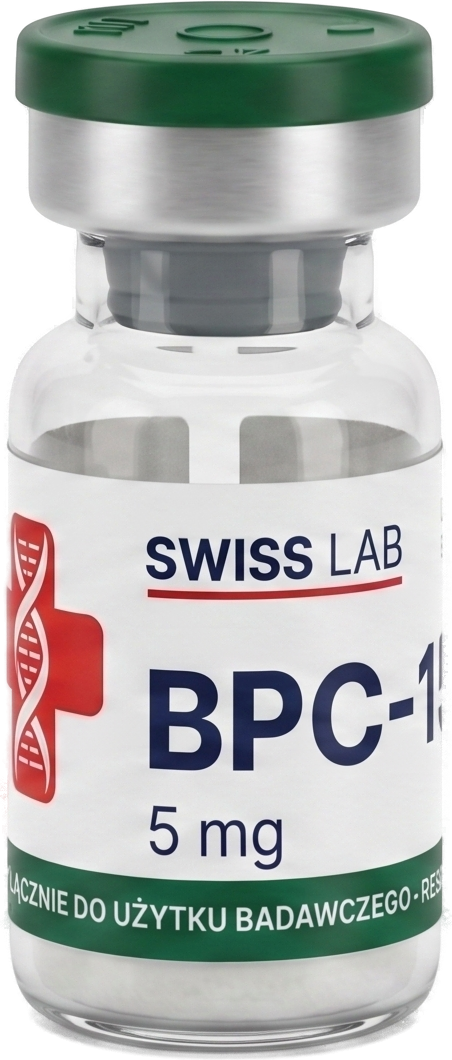
BPC-157 (short for Body Protection Compound) is a synthetic peptide — a short chain of fifteen amino acids, the building blocks of proteins. Among biohackers and athletes it has acquired a reputation as a “universal recovery agent”. In reality the picture is far more complex than the advertising slogans. On one hand there is a good deal of laboratory research, carried out mainly by Professor Predrag Sikirić's team at the University of Zagreb. On the other, almost all of that knowledge comes from animal and cell studies, and there is very little human data. This article sets out what is known about BPC-157 from reputable scientific publications and clearly separates confirmed fact from hope and conjecture. The text is educational and research-oriented only.
What BPC-157 is and where it comes from
BPC-157 is a fragment of a larger protein found in human gastric juice. Researchers isolated that piece and described it as a stable peptide protecting the cells lining the digestive tract from damage. Hence the name “body protection compound”. Important: BPC-157 in the form in which it is studied is a molecule made in the laboratory. It does not occur in the body as a standalone peptide — it was designed on the model of a fragment of a natural protein.
Most of the basic research on this peptide came from a single centre — the School of Medicine at the University of Zagreb. That is itself important information when judging reliability: science values results independently confirmed by many different laboratories more highly than a large body of work from a single group.
Structure and composition
BPC-157 consists of fifteen amino acids in a defined order. The molecule has a mass of about 1419 (in the units used to weigh molecules). A characteristic feature of its structure is a triple repeat of the amino acid proline. Proline has a rigid, ring-shaped form that introduces “kinks” into the chain and hinders access by protein-degrading enzymes. That explains why this molecule is unusually resistant to breakdown.
How it may work — forming new blood vessels
The best-documented action of BPC-157 is its effect on the formation of new blood vessels (technically called angiogenesis). A paper published in the Journal of Molecular Medicine (Hsieh and colleagues, 2017) showed that BPC-157 increased vessel numbers both in living models (on the chick embryo membrane) and in cells grown in a dish. In a rat model of limb ischaemia the peptide accelerated the restoration of blood flow.
At the cellular level, the key role is attributed to a receptor on the cell surface that responds to signals promoting vessel growth. BPC-157 did not increase the amount of the growth factor itself but amplified the action of that receptor, setting off a chain of reactions leading to the production of nitric oxide — a molecule that dilates vessels, regulates blood flow and supports cell survival. A second, independent route to the same effect has also been described, suggesting the peptide may drive nitric oxide production in several ways at once.
One important caveat has to be stressed, though: these results come from cell culture and animal studies. They show that such a mechanism is biologically plausible, but they do not prove that it translates into an effect in humans.
What has been studied in animals and cells
The range of animal studies testing BPC-157 is very broad. The publications describe, among others:
- The digestive tract — models of gastric ulcer, intestinal inflammation and mucosal damage.
- Tendons and ligaments — models of Achilles tendon transection and ligament injury.
- Muscle — muscle injuries and injuries at the muscle-tendon junction.
- Bone and skin — fracture and wound healing.
- Organ protection — liver, pancreas, heart and brain in injury models.
The common explanation offered for these effects is better blood supply to injured tissue, stimulation of the cells responsible for rebuilding it, and stabilisation of neuromuscular connections — particularly in poorly vascularised tissue such as tendon.
Tissue recovery — how to read these results
A review published in 2025 in Current Reviews in Musculoskeletal Medicine (McGuire and colleagues) summarised the data on BPC-157 in the healing of muscle, tendon and bone. The authors confirm that the peptide “shows strong regenerative and protective effects in animal and cell studies”, improving outcomes in injury models.
The same review, however, makes the key qualification: only three preliminary studies have assessed BPC-157 in humans, and “proper large-scale trials simply do not exist”. The authors' conclusion is clear — BPC-157 should be treated as an experimental compound, and its use approached with caution until it has been properly studied in people.
The digestive tract — the original application
BPC-157 was originally described above all as a factor protecting the cells of the digestive tract. Animal studies observed faster ulcer healing and protection of the mucosa against irritants. That is where the observation about the molecule's unusual stability in the stomach, discussed below, comes from. It must be stressed again, though: these are animal data — they are not proof that the peptide treats digestive disease in humans.
The arginine form and stability
Publications describe BPC-157 as stable in human gastric juice — resistant to breakdown for over a day. That stability is linked to the molecule's structure, including the triple proline repeat that hinders protein-degrading enzymes.
Two forms are found in the research trade: the plain one and one bound to arginine (an amino acid). Arginine is added mainly for technical reasons — it improves the preparation's stability and solubility under laboratory conditions. Advertising claims that the arginine form “substantially increases absorption after swallowing in humans” should be treated with caution — that is conjecture going beyond the results of sound research. Whatever the form, peptides have to be stored properly; the rules are set out in our guides on refrigerated storage and on reconstituting peptides.
Safety and the limits of the data
No lethal dose was established in animal studies, and the few preliminary human studies reported no adverse effects. An absence of reported adverse effects is not the same as proven safety, though — it follows above all from the very small number of participants and the lack of long follow-up. A theoretical concern is also worth flagging: because the peptide promotes the formation of blood vessels, questions arise as to whether it might also favour the growth of tumour tissue — that requires further study.
The regulations matter too. BPC-157 is not approved for human use by authorities such as the US FDA. Since 2022 it has been banned by the World Anti-Doping Agency (WADA) among substances not approved for market. In several countries it is treated as a prescription substance, though in practice it is not available there in medical care.
The state of the research, and a summary
BPC-157 is one of the most interesting — and most often misrepresented — peptides in the longevity world. From a scientific standpoint the picture is coherent: a rich and internally consistent base of animal and cell studies (promotion of vessel formation, cell protection, better healing in animal models) alongside almost no human evidence. The mechanisms are biologically plausible, but a plausible mechanism does not substitute for proper clinical trials in people.
The honest summary is this: a promising candidate for further research, not a proven therapeutic agent. Every claim of a “regenerative” effect in humans should be treated as a hypothesis, not a fact. The level of evidence for BPC-157 remains at the animal and cell stage.
Sources
- Sikiric P. et al. Stable Gastric Pentadecapeptide BPC 157, Robert's Stomach Cytoprotection/Adaptive Cytoprotection/Organoprotection, and Selye's Stress Coping Response. Inflammopharmacology, 2020. PMC7096228
- Hsieh M-J. et al. Therapeutic potential of pro-angiogenic BPC157 is associated with VEGFR2 activation and up-regulation. Journal of Molecular Medicine, 2017; 95:323–333. doi:10.1007/s00109-016-1488-y
- Hsieh M-J. et al. Modulatory effects of BPC 157 on vasomotor tone and the activation of Src-Caveolin-1-endothelial nitric oxide synthase pathway. Scientific Reports, 2020. PMC7555539
- McGuire FP. et al. Regeneration or Risk? A Narrative Review of BPC-157 for Musculoskeletal Healing. Current Reviews in Musculoskeletal Medicine, 2025. PMID 40789979
- BPC-157. Wikipedia (sequence and FDA/WADA regulatory status sections). en.wikipedia.org/wiki/BPC-157
For in-vitro laboratory research only. It is not a human medicine and is not for treatment.