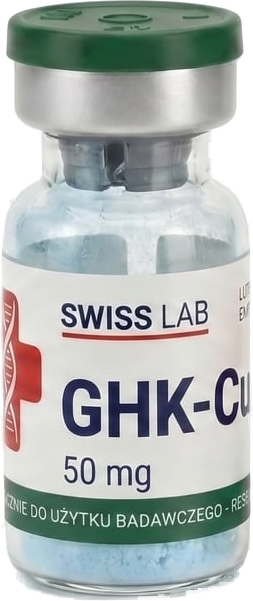
GHK-Cu is one of the best-described short peptides in the scientific literature (a peptide is a small chain of amino acids, the building blocks of proteins). Its name comes from three amino acids — glycine, histidine and lysine — bound to a copper ion. Copper in Latin is cuprum, hence the “Cu” in the name. Unlike many synthetic research compounds, GHK is a peptide that occurs naturally in the human body, and its action has been studied for decades — mainly on cells in culture and in the context of skin and cosmetics. In this article we set out what really follows from the reputable publications on GHK-Cu, where the hard data end and where conjecture begins. The material is scientific and informational only and concerns a reagent intended for laboratory research.
What GHK is and where it comes from
GHK was isolated in 1973 by the biochemist Loren Pickart as an active component of human plasma (the liquid part of blood). He noticed that a certain plasma fraction made older liver tissue start producing proteins as though it were younger. The peptide occurs naturally in human plasma, saliva and urine. A characteristic observation from Pickart's work is the fall in GHK with age: values of about 200 units were reported in young adults and about 80 in people around sixty. That observation became the starting point for the hypothesis that GHK is a natural tissue-repair signal that diminishes with age.
The bond with copper — why the “Cu” matters
This peptide binds copper very readily. In the presence of copper it spontaneously forms a stable GHK-Cu complex. Copper is not an incidental extra here — it is an element essential to many enzymes (proteins that speed up reactions in the body) involved in tissue remodelling, including the stiffening of collagen and elastin and the protection of cells from damage. The literature describes GHK as a kind of copper carrier and regulator for cells: it eases the metal's transport and makes it available at a given site, which matters both for tissue repair and for protection against stress. That combination of a peptide “address” with active copper underlies most of the proposed mechanisms of action.
How it works: collagen and the tissue scaffold
The best-documented thread concerns the effect of GHK and GHK-Cu on the tissue scaffold — the network of proteins and molecules filling the space between cells and giving tissue its shape and elasticity. In studies on skin cells (fibroblasts) the peptide stimulated the production of the components needed to rebuild that scaffold — collagen and other supporting molecules of the skin. Importantly, this action is not one-directional: GHK influences both the formation and the controlled breakdown of the network's components, regulating the enzymes that dismantle it and the proteins that inhibit those enzymes. Such a bidirectional profile is sometimes described as tissue “remodelling” rather than mere protein accumulation. Pickart and colleagues set out this model in detail in review papers from 2015 and 2018.
Wound healing and the recruitment of repair cells
In the healing context, GHK-Cu has been described as a factor supporting several related processes: attracting repair cells (immune cells and vascular cells among them), supporting the formation of blood vessels and easing inflammation. The literature notes that GHK-Cu may damp an excessive inflammatory response, which when too strong favours scarring. Most of these observations come from cell and animal studies. It is worth stressing that the data concern mainly topical applications (to skin, to wounds) rather than systemic use in humans.
Skin, cosmetics and “remodelling”
GHK-Cu is most extensively studied precisely in the area of skin — and that area supplies the most practical data. Review papers list observations such as improved elasticity, density and firmness of the skin, shallower fine lines, reduced signs of sun-related ageing and pigmentation, and stimulation of skin-cell proliferation. Some of these data come from cosmetic evaluations, which puts GHK-Cu in an unusual position: it has more skin data than many similar compounds. Those results have to be read carefully, though — they differ in study method, participant numbers and the quality of the comparisons.
Protective action and effects on genes
The second heavily studied thread is protection of cells against damage and effects on gene activity. Analyses cited by Pickart and Margolina indicate that GHK may affect the activity of around 4,000 human genes — stimulating some and quietening others. Among them, activation of many cell-protective genes and quietening of inflammation-related ones have been described. At the chemical level GHK-Cu has been linked to blocking the formation of harmful cell-damaging molecules, neutralising toxic products and protecting skin cells from UV in a dish. A more recent example is a 2024 paper in which GHK-Cu eased lung inflammation and fibrosis in mice through binding to a specific protective protein — showing that specific target proteins are now being identified, not just general effects.
What has actually been shown — and the limitations
An honest assessment requires separating the levels of evidence:
- Stronger data: effects on gene activity, on the production of collagen and scaffold components, and on cell protection — repeatedly demonstrated in a dish and in some animal studies.
- Intermediate data: effects on skin and topical healing — described, but partly in cosmetic studies of varying quality.
- A clear gap: large, well-designed human trials confirming action on the whole organism. Most of the literature cited consists of reviews and mechanistic studies, largely by the same research group.
In other words: GHK-Cu has an unusually rich scientific base for a research peptide, but it should not be confused with a compound of proven therapeutic efficacy. Claims of “rejuvenation” or general bodily regeneration go beyond what has actually been shown.
Use as a laboratory reagent
In research, GHK-Cu is sometimes used as a tool for studying repair and cell-protection processes — as a model copper carrier for studying the transport of that metal, as a factor affecting gene activity in skin-cell cultures, and as a reference point in work on the tissue scaffold. Its well-described action makes it a useful comparator in experiments. All such uses remain within laboratory work and are not medical in nature.
Summary
GHK-Cu is a natural plasma peptide that forms an active complex with copper and, according to the reputable literature, takes part in remodelling the tissue scaffold, stimulates collagen production, supports healing, protects cells and affects the activity of many genes. Most of the data come from work in a dish and from the skin and cosmetics field; what is missing are large human trials confirming action on the whole organism. GHK-Cu is therefore best treated as a well-described, interesting object of research rather than an agent of proven therapeutic efficacy.
Sources
- Pickart L, Margolina A. Regenerative and Protective Actions of the GHK-Cu Peptide in the Light of the New Gene Data. Int J Mol Sci. 2018;19(7):1987. doi:10.3390/ijms19071987
- Pickart L, Vasquez-Soltero JM, Margolina A. GHK Peptide as a Natural Modulator of Multiple Cellular Pathways in Skin Regeneration. BioMed Res Int. 2015;2015:648108. doi:10.1155/2015/648108
- Pickart L, Vasquez-Soltero JM, Margolina A. The Effect of the Human Peptide GHK on Gene Expression Relevant to Nervous System Function and Cognitive Decline. Brain Sci. 2017;7(2):20. doi:10.3390/brainsci7020020
- Pickart L, Vasquez-Soltero JM, Margolina A. The Human Tripeptide GHK-Cu in Prevention of Oxidative Stress and Degenerative Conditions of Aging. Oxid Med Cell Longev. 2012;2012:324832. doi:10.1155/2012/324832
- Pickart L, Margolina A. Skin Regenerative and Anti-Cancer Actions of Copper Peptides. Cosmetics. 2018;5(2):29. doi:10.3390/cosmetics5020029
- The glycyl-l-histidyl-l-lysine-Cu2+ tripeptide complex attenuates lung inflammation and fibrosis in silicosis by targeting peroxiredoxin 6. Redox Biol. 2024;75:103237. doi:10.1016/j.redox.2024.103237
For in-vitro laboratory research only. It is not a human medicine and is not for treatment.