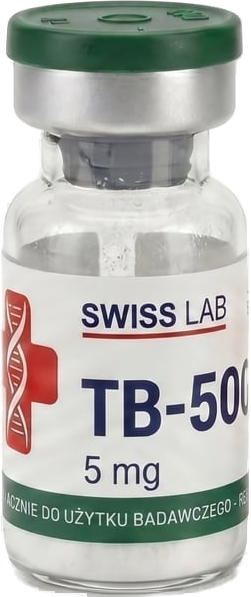
TB-500 is the name used in the reagent trade for a synthetic peptide corresponding to a fragment of the natural protein thymosin beta-4. Thymosin beta-4 is one of the best-studied proteins in its family and has been researched for decades in the context of cell structure and tissue healing. A great many simplifications and advertising promises have grown up around “TB-500”, though, so it is worth separating what has genuinely been shown in reputable publications from what remains conjecture. This article is educational only and sets out the current state of knowledge — with no dosing information and no encouragement to self-administer.
What TB-500 is
The name TB-500 usually refers to a short synthetic peptide containing the so-called actin-binding fragment of thymosin beta-4 (actin is one of the basic proteins building the cell's skeleton). The key distinction is this: thymosin beta-4 is the whole natural protein (43 amino acids, that is 43 building blocks), whereas “TB-500” in laboratory practice is only its short, active fragment. The distinction matters, because the overwhelming majority of proper studies — including human ones — concerned the whole protein, not the seven-amino-acid piece sold as a reagent.
The relationship to thymosin beta-4
Thymosin beta-4 occurs in almost every cell of the body and is the most abundant protein of its family in mammalian tissue. Its main job is to bind free actin molecules and control how much of it is available. It was from this protein that the idea for TB-500 came: researchers established that its biologically important fragment lies in the middle section. It is worth stressing that although the fragment reproduces a key element, it is not the same as the whole protein and does not necessarily have all its properties.
Structure and the active fragment
The whole protein consists of 43 amino acids. In its middle section there is a short, highly conserved fragment (written in shorthand as LKKTET) common to the whole family of these proteins. It is often colloquially called the “actin-binding fragment”. Caution is needed, though: detailed structural analyses show that when the protein binds actin, practically its entire length is in contact with it, not just that short fragment. The fragment is therefore the core of the action, but not the only element determining the whole protein's activity.
How it works — binding actin
The best-documented job of thymosin beta-4 is regulating the cell's actin skeleton. The protein binds individual actin molecules one to one and keeps them in a state in which they do not assemble into long filaments. That gives the cell a reserve of actin ready for immediate use when cell movement, a change of shape or the formation of protrusions is needed. That same actin-binding ability has been linked to promoting the formation of blood vessels: work by Philp and colleagues showed that it is precisely this short, seven-amino-acid fragment that is necessary to stimulate vessel formation, and that peptides without it were inactive.
What was studied in animals and cells
In cells and in animals, thymosin beta-4 was studied in the context of several healing processes:
- Cell movement — stimulating the migration of cells lining blood vessels, skin cells and other cells involved in healing.
- Formation of blood vessels — supporting the movement and attachment of vascular cells and the formation of vessel structures in a dish.
- Easing inflammation — a reduction of the inflammatory response was described in wound-healing models.
- Tissue repair — the heart, skin, corneal surface of the eye and hair follicles were studied.
These are mainly data from animal and cell studies, however. Observations from cell culture and from mice or rats do not translate automatically into effects in humans and should be treated as directions for further research, not as proven therapeutic action.
The heart and blood vessels
One of the most frequently cited areas is cardiac repair. In animal studies thymosin beta-4 was described as a factor supporting the survival of heart-muscle cells after ischaemia, attracting cells to the heart and forming vessels. On that basis an investigational intravenous drug was developed (designated RGN-352) and tested for safety and tolerability in patients after a heart attack (trial registration: NCT01311518). It is an important example of the whole protein reaching human trials — but it does not mean proven efficacy, nor does it apply to the fragment sold as a reagent.
Wound healing, skin and tendons
Thymosin beta-4 was studied as a factor accelerating healing in skin models — stimulation of skin-cell movement, vessel formation and easing of inflammation were described. Early studies of topical use in hard-to-heal wounds were also carried out. The claims about rebuilding tendons and ligaments often repeated among biohackers rest chiefly on transferring the protein's general properties to those tissues and on animal studies — solid human research on “TB-500” in tendon injury simply does not exist. That distinction is essential to an honest assessment.
Human data
The strongest human data on thymosin beta-4 come from ophthalmology (the treatment of eye disease). A preparation in eye-drop form (RGN-259) was tested in well-designed studies in dry eye syndrome and corneal damage. In one study in severe dry eye (Sosne and colleagues, Cornea 2015) a clear reduction in eye discomfort was shown compared with placebo (an inert substance with no action). Later, larger studies gave equivocal results, however — some did not confirm the main assumptions, partly because of a strong placebo effect. The overall picture is therefore this: thymosin beta-4 has real human data in narrow applications (mainly the ocular surface), but it is far from being a universal “recovery peptide”, and the TB-500 fragment itself has not been studied in humans in a way that confirms efficacy.
Safety and limitations
In human studies of thymosin beta-4 (eye drops, the intravenous form) tolerability was generally described as good, but these were studies in small numbers of people over short periods, designed for specific diseases. They provide no data on long-term systemic use without medical supervision. In addition:
- A reagent is not a medicine — TB-500 sold for research is not subject to the quality control applied to medicines; the purity and composition of such preparations can vary.
- A gap in the evidence — most of the promises concern the fragment, while most of the proper research concerned the whole protein.
- The sporting context — compounds of this group may be covered by anti-doping rules; that is a separate matter to be checked against the current regulations.
Summary
TB-500 is a fragment reproducing the active element of thymosin beta-4 — a protein with a well-described role in cell structure, cell movement and vessel formation. The animal data on repair of the heart, skin and cornea are promising, and in ophthalmology there are real human studies of the whole protein. At the same time, honesty is required: most of the evidence comes from animal and cell studies, concerns the whole protein rather than the fragment alone, and does not confirm the efficacy of “TB-500” as a therapeutic agent in humans. For anyone interested in the subject scientifically, the most rewarding approach is to go to the reputable publications and distinguish conjecture from demonstrated fact.
Sources
- Goldstein AL, Hannappel E, Kleinman HK. Thymosin beta4: actin-sequestering protein moonlights to repair injured tissues. Trends Mol Med. 2005 (PMID: 16099219).
- Philp D, Huff T, Gho YS, Hannappel E, Kleinman HK. The actin binding site on thymosin beta4 promotes angiogenesis. FASEB J. 2003 (PMID: 14500546).
- Philp D, Goldstein AL, Kleinman HK. Thymosin beta4 promotes angiogenesis, wound healing, and hair follicle development. (PMID: 15037013).
- Sosne G, Dunn SP, Kim C. Thymosin β4 significantly improves signs and symptoms of severe dry eye in a phase 2 randomized trial. Cornea. 2015 (PMID: 25826322).
- RGN-259 (Thymosin β4) Ophthalmic Solution in Neurotrophic Keratopathy — a randomised, placebo-controlled phase III trial (PMC9820614).
- ClinicalTrials.gov: A Study of the Safety and Efficacy of Injectable Thymosin Beta 4 (RGN-352) for Treating Acute Myocardial Infarction (NCT01311518).
For in-vitro laboratory research only. It is not a human medicine and is not for treatment.