
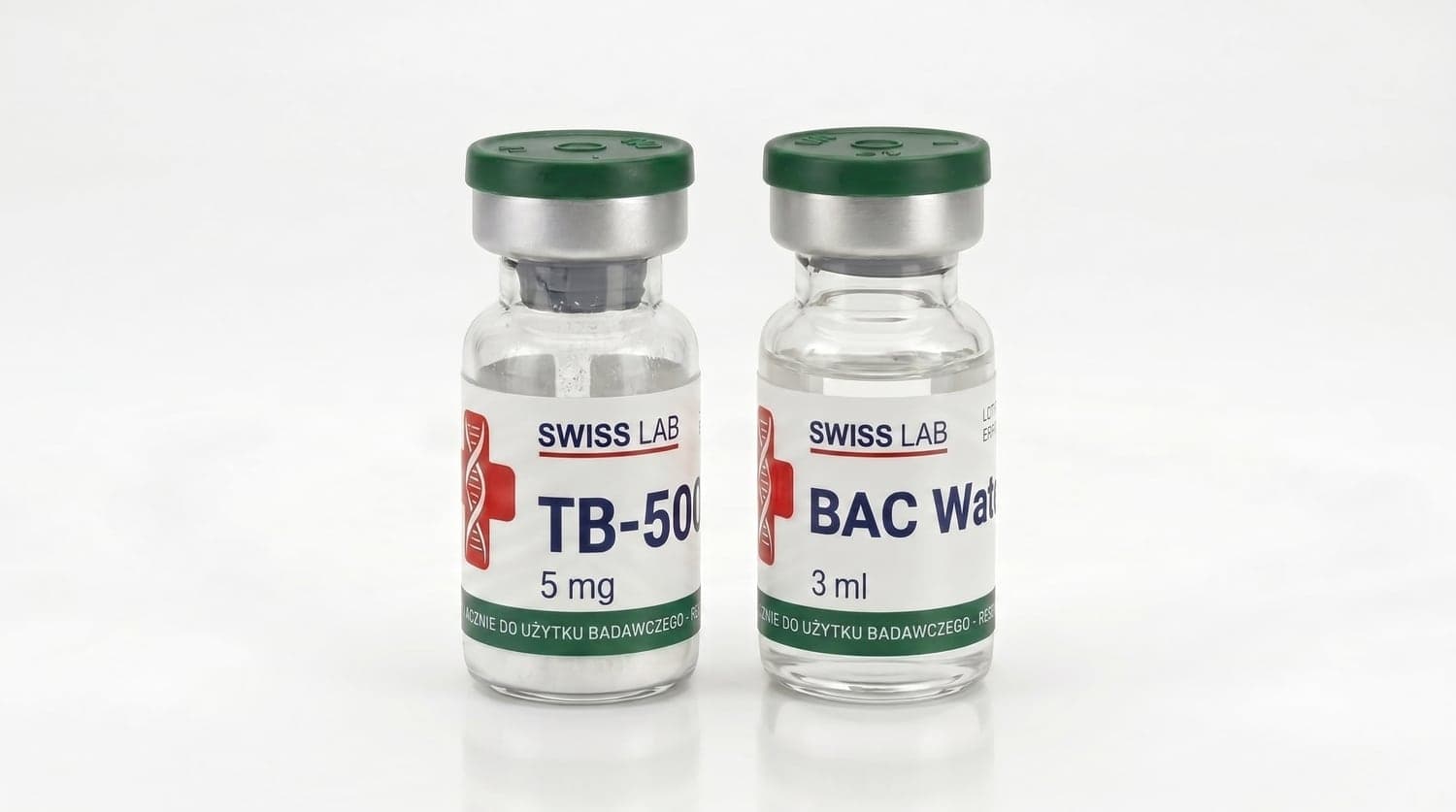
What TB-500 is
TB-500 is a peptide — a short chain of amino acids, the building blocks of proteins. It corresponds to a fragment of a natural protein called thymosin beta-4, which the body produces itself. It is especially abundant in platelets, which gather wherever tissue has been damaged.
In research samples TB-500 is usually the key active fragment of that protein. The protein binds actin — one of the basic structural materials inside cells. That is why researchers study it in the context of cell movement and tissue repair. The binding was measured in a straightforward laboratory assay (study on PubMed).
Note: what follows is scientific information only. Most of the data on TB-500 comes from cell cultures and animal studies, not from confirmed treatment in humans.
How it works (in short)
Its best-characterised action is binding actin inside the cell. That influences how cells change shape and move — which matters for healing and tissue rebuilding. A general review of these functions has been published (review on PubMed).
In animal studies it has also been linked to the formation of new blood vessels and to reduced inflammation. Researchers noted that the same fragment that binds actin also promotes vessel formation (study on PubMed).
All of this is still under investigation. These mechanisms have not been confirmed as an established treatment in humans.
What is being studied
The most frequently studied area is wound healing and tissue repair. Animal studies have described faster skin repair (skin-healing study, PubMed). There have also been early human trials in hard-to-heal leg ulcers (European trial, PubMed).
A second direction is cardiac protection and repair. In animal models of myocardial infarction the protein was associated with better cell survival and new vessel formation (cardiac study, PMC).
The eye, bone and blood vessels are studied too. In all of these areas the evidence comes mainly from animals or early trials. It is not proof of efficacy or safety in humans and is not a health claim.
For in-vitro laboratory research only. Not for human or animal consumption and not for treatment.