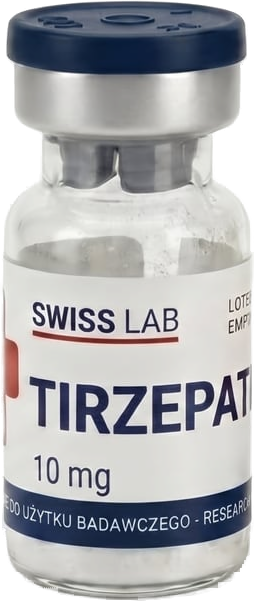
Tirzepatide (sold as Mounjaro in diabetes and Zepbound in obesity, by Eli Lilly) is the first drug that activates two gut hormones at once — GLP-1 and GIP. In trials comparing it head-to-head with semaglutide it did better both in blood-sugar control and in weight loss, setting a new benchmark. The review below rests solely on peer-reviewed publications (the NEJM) and regulatory data, and explains why adding a second hormone (GIP) to GLP-1 action proved so effective.
What tirzepatide is
Tirzepatide is a synthetic peptide built from 39 “blocks” (amino acids). Its structure derives from the natural hormone GIP, but was altered so that it also activates a second “switch” — the GLP-1 receptor. A receptor is the site in the body a hormone activates to produce an effect. A fatty chain was attached to the molecule, binding it to a blood protein (albumin) and extending its action to about 5 days — so one injection a week suffices. It is an example of deliberate drug design: instead of combining two separate molecules, one was created that acts on two hormones at once.
GLP-1 and GIP — two gut hormones
Gut hormones (incretins) are released after a meal and make the pancreas release more insulin when blood sugar is raised. The two most important are GLP-1 and GIP. GLP-1 slows gastric emptying, suppresses the sugar-raising hormone (glucagon) and acts on satiety centres in the brain, reducing appetite. GIP accounts for a large part of the incretin effect — in healthy people it is GIP, not GLP-1, that most strongly stimulates insulin release after a meal. A broader discussion of these hormones is in our article on the metabolic peptides GLP-1, GIP and glucagon.
Structure and duration of action
Tirzepatide is given by subcutaneous injection, with the dose raised slowly to limit digestive symptoms. The trials used target doses of 5 mg, 10 mg and 15 mg a week. Its long duration of action gives a steady drug level and one injection a week, which makes long-term use easier. The molecule “fits” the GIP hormone about as strongly as the natural hormone does, and GLP-1 deliberately somewhat less strongly — and that asymmetric profile turned out to be advantageous in practice.
Why adding GIP increases both efficacy and tolerability
GIP on its own was for years considered ineffective, and even potentially harmful, in metabolic terms. The breakthrough was combining the two signals. There are probably two benefits to acting on two hormones at once. First — a stronger effect on satiety and on energy expenditure: GIP receptors in the brain may amplify GLP-1's appetite suppression and act on adipose tissue. Second — better digestive tolerability: animal studies suggest that activating GIP in the brain may ease the nausea and vomiting caused by GLP-1. In theory that allows greater efficacy with bearable symptoms. The result is a drug that acts more strongly than GLP-1 stimulation alone can.
Type 2 diabetes — the SURPASS trials
Efficacy in type 2 diabetes was documented in the large SURPASS programme. The most frequently cited is SURPASS-2 — a 40-week trial comparing tirzepatide directly with semaglutide 1 mg, both added to metformin (1,879 participants). Blood sugar was assessed by HbA1c (glycated haemoglobin — it reflects average sugar over recent weeks). The reduction in that measure was −2.09% (5 mg), −2.37% (10 mg) and −2.46% (15 mg) for tirzepatide against −1.86% for semaglutide. Weight loss reached −7.8 kg, −10.3 kg and −12.4 kg for tirzepatide against −6.2 kg for semaglutide. On every comparison tirzepatide proved clearly superior to semaglutide — in sugar control and in weight loss alike. The results were published in the New England Journal of Medicine in 2021.
Obesity — the SURMOUNT trials
The registration trial in obesity, SURMOUNT-1 (Jastreboff et al., NEJM 2022), enrolled 2,539 adults with obesity or overweight without diabetes, randomly assigned to tirzepatide 5/10/15 mg or placebo (an inert substance) for 72 weeks. The average weight reduction was −15.0% (5 mg), −19.5% (10 mg) and −20.9% (15 mg), against only −3.1% in the placebo group. As many as 89–91% of participants on the 10 and 15 mg doses lost at least 5% of their weight, and about 57% of those on 15 mg lost at least 20%. That approaches the results of stomach-reduction surgery and is clearly better than earlier drugs. In the head-to-head SURMOUNT-5 trial, tirzepatide also outperformed semaglutide in people with obesity but without diabetes.
Other uses — sleep apnoea and liver disease (MASH)
Tirzepatide's action goes beyond sugar and weight. In the SURMOUNT-OSA programme (NEJM 2024), comprising two trials in adults with moderate-to-severe sleep apnoea (a disorder in which breathing stops during sleep) and obesity, tirzepatide clearly reduced the number of breathing pauses, body weight, inflammation and blood pressure. In the liver, the SYNERGY-NASH trial (NEJM 2024) showed that in patients with metabolic-dysfunction-associated steatohepatitis (MASH), tirzepatide produced resolution of the disease without worsening of liver scarring in 51.8% (5 mg), 62.8% (10 mg) and 73.3% (15 mg) of patients, against 13.2% on placebo, after 52 weeks. That confirms the broad effect of this drug class across metabolism as a whole.
Safety and tolerability
Tirzepatide's adverse effects are typical of this drug class and mainly involve the digestive system — nausea, diarrhoea, constipation and vomiting. They are usually mild or moderate, appear chiefly while the dose is being raised and ease over time; slow escalation limits how often they occur. As across the class, a risk of acute pancreatitis has been described and — in rodent studies — thyroid tumours (their significance in humans remains uncertain). Treatment and eligibility are always decided by a doctor.
Its place among the drugs — semaglutide, tirzepatide, retatrutide
Tirzepatide occupies a middle position in the development of these drugs. Semaglutide acts only on GLP-1 — described in more detail in our article on semaglutide and its trials — and remains the reference point, but in head-to-head comparisons (SURPASS-2, SURMOUNT-5) it came second to tirzepatide. Tirzepatide, by adding the GIP hormone, raised the efficacy bar. The next step is retatrutide — a still-investigational drug acting on three hormones at once (GLP-1, GIP and glucagon) — which in early trials suggests even greater weight loss; its action is covered in a separate piece on retatrutide's triple agonism. The direction is clear: from one hormone, through two, towards three targets at once.
Summary
Tirzepatide is a well-documented drug acting on two gut hormones (GLP-1 and GIP) which in rigorous trials outperformed a drug acting only on GLP-1 — in type 2 diabetes (SURPASS) and in obesity (SURMOUNT, up to about 20.9% weight loss at 15 mg) alike, and additionally helped in sleep apnoea (SURMOUNT-OSA) and in MASH liver disease (SYNERGY-NASH). The hypothesis that adding the GIP hormone increases both efficacy and tolerability compared with GLP-1 alone has been strongly borne out by the trial data. Tirzepatide is at once a mature drug and a bridge to the next generation of drugs acting on several hormones at once.
Sources
- Jastreboff AM, Aronne LJ, Ahmad NN, et al. (SURMOUNT-1 Investigators). Tirzepatide Once Weekly for the Treatment of Obesity. N Engl J Med. 2022;387(3):205-216. doi:10.1056/NEJMoa2206038
- Frías JP, Davies MJ, Rosenstock J, et al. (SURPASS-2). Tirzepatide versus Semaglutide Once Weekly in Patients with Type 2 Diabetes. N Engl J Med. 2021;385(6):503-515. doi:10.1056/NEJMoa2107519
- Malhotra A, Grunstein RR, Fietze I, et al. (SURMOUNT-OSA). Tirzepatide for the Treatment of Obstructive Sleep Apnea and Obesity. N Engl J Med. 2024;391(13):1193-1205. doi:10.1056/NEJMoa2404881
- Loomba R, Hartman ML, Lawitz EJ, et al. (SYNERGY-NASH). Tirzepatide for Metabolic Dysfunction–Associated Steatohepatitis with Liver Fibrosis. N Engl J Med. 2024;391(4):299-310. doi:10.1056/NEJMoa2401943
For in-vitro laboratory research only. It is not a human medicine and is not for treatment.