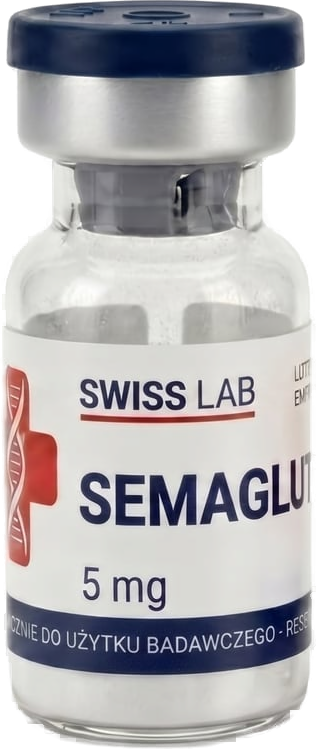
Semaglutide is a synthetically improved version of the natural human hormone GLP-1. It was developed by Novo Nordisk. It is known from the preparations Ozempic and Rybelsus (used in type 2 diabetes) and Wegovy (in obesity). Of all the investigational peptides affecting metabolism, semaglutide has the richest and strongest body of scientific evidence — from large trials involving thousands of people to studies of its effect on the heart and blood vessels. This review gathers the key findings from the scientific literature on how it works, how it is built and what the trials showed.
What semaglutide is
Semaglutide belongs to the group of GLP-1 receptor agonists. A GLP-1 agonist is a molecule that activates the same “switch” in the body as the natural hormone GLP-1. Semaglutide is 94 per cent identical in construction to human GLP-1, but small chemical changes make it act far longer in the body. It has been studied both as a once-weekly subcutaneous injection and in an innovative tablet form. It is the comparator against which newer peptides acting on several “switches” at once, such as tirzepatide and retatrutide, are measured.
GLP-1 and the gut hormones (incretins)
GLP-1 is a hormone released by the gut after a meal. It belongs to the incretins — gut hormones that make the pancreas release more insulin after eating. Natural GLP-1 is destroyed very quickly in the body by an enzyme called DPP-4, however, so without improvements it would be unusable as a medicine. A broader discussion of these hormones and a comparison of GLP-1, GIP and glucagon is in our article on metabolic peptides: GLP-1, GIP and glucagon.
How it is built and how long it acts
Semaglutide acts so long thanks to three changes in its structure. First, elements were substituted at two points of the molecule so that DPP-4 cannot break it down quickly. Second, a long fatty chain was attached to it. That attached fat makes the molecule bind strongly but reversibly to a blood protein (albumin). As a result the body clears it and breaks it down more slowly.
The effect is that half the dose only disappears from the body after about a week (roughly 165 hours). That allows convenient once-weekly dosing by subcutaneous injection. The tablet form (Rybelsus) deals with the fact that a peptide would normally be broken down in the stomach — an additive abbreviated SNAC was included, which locally eases absorption of the drug through the stomach wall. Even so, very little of the drug is absorbed from the tablet (of the order of 0.4–1 per cent), which is why tablet doses are given in much larger amounts than injected ones.
How it works
Semaglutide mimics and amplifies the action of natural GLP-1 at several points. In the pancreas it makes insulin release happen only when blood sugar is raised — and as sugar falls, that action weakens, which reduces the risk of dangerously low sugar. At the same time it suppresses the release of glucagon (the hormone that raises sugar). In the brain it acts on the centres governing appetite and satiety, so it reduces hunger and food intake. In the stomach it slows emptying, so fullness after a meal lasts longer. The combination of these effects explains both the better sugar control and the marked fall in body weight.
Type 2 diabetes — the SUSTAIN trials
The efficacy and safety of semaglutide injections in type 2 diabetes were tested in a large programme called SUSTAIN. In SUSTAIN 1–5 and 7 (over 5,000 participants in 33 countries in total) semaglutide at 0.5 and 1.0 mg consistently outperformed placebo (an inert substance) and other comparator drugs — in lowering blood sugar and body weight. Sugar was assessed by HbA1c, glycated haemoglobin, which reflects average sugar over the preceding weeks. In SUSTAIN 1 semaglutide lowered that measure by 1.4–1.8 points, against 0.1 points in the placebo group. SUSTAIN 6 was particularly important (3,297 people with type 2 diabetes and high risk), in which semaglutide reduced the risk of major cardiac events (cardiovascular death, heart attack or stroke) by 26 per cent compared with placebo (6.6 versus 8.9 per cent of cases). Cardiac safety for the tablet was confirmed in the PIONEER programme.
Obesity — the STEP trials
In people with obesity and overweight, semaglutide was studied in the STEP programme at the higher dose of 2.4 mg once weekly. In the landmark STEP 1 trial (published in the New England Journal of Medicine in 2021), adults with overweight or obesity but without diabetes received semaglutide 2.4 mg or placebo for 68 weeks, alongside lifestyle change. The average weight reduction was 14.9 per cent in the semaglutide group against 2.4 per cent on placebo, and 86 per cent of participants lost at least 5 per cent of their weight. The scale and durability of that effect set a new benchmark in the drug treatment of obesity.
Cardiac benefit — the SELECT trial
The SELECT trial (published in the same journal in 2023) was the first to show a cardiac benefit in people with obesity but without diabetes. It enrolled people aged at least 45 with overweight or obesity and established heart or vascular disease (after a heart attack or stroke, or with atherosclerosis, for instance). Semaglutide 2.4 mg once weekly, added to usual treatment, over an average follow-up of about 40 months reduced the risk of major cardiac events by about 20 per cent (cardiovascular death, heart attack or stroke) compared with placebo. That result changed how semaglutide is seen — from a “weight-loss drug” to one with a proven effect on heart health.
Safety and adverse effects
The most frequently reported adverse effects of semaglutide involve the digestive system: nausea, vomiting, diarrhoea and constipation. They are usually mild or moderate, intensify at the start of treatment and as the dose is raised, and ease over time — which is why the trials escalated the dose gradually. The official product information also lists warnings about pancreatitis and gallstones, and a contraindication in people with a rare familial thyroid cancer (based on rodent studies). This material is informational and scientific only and contains no dosing recommendations — the doses given describe only how the cited trials were conducted.
Its place among the drugs and the research context
Semaglutide is today the basic reference point — it acts on one “switch” (GLP-1) and drugs with broader action are compared against it. Tirzepatide activates two switches at once (GLP-1 and GIP), and the still-investigational retatrutide acts on three (GLP-1, GIP and glucagon). Their action is described in more detail in our article on retatrutide — the triple agonist. Despite the arrival of these newer molecules, semaglutide remains the best-documented member of its group — with data on sugar control, weight loss and heart health.
Summary
Semaglutide is a carefully improved version of the hormone GLP-1: changes protecting it from breakdown and an attached fat binding the molecule to a blood protein allow once-weekly dosing, and a special additive allows a tablet form too. Its action — sugar-dependent insulin release, appetite suppression and slowed gastric emptying — produces consistent results in three areas: diabetes control (SUSTAIN), weight loss (STEP 1: about 14.9 per cent) and cardiac protection (SELECT: about 20 per cent fewer major events). That makes it one of the best-studied peptides in modern metabolic medicine.
Sources
- Wilding JPH et al. Once-Weekly Semaglutide in Adults with Overweight or Obesity (STEP 1). N Engl J Med. 2021;384:989-1002.
- Lincoff AM et al. Semaglutide and Cardiovascular Outcomes in Obesity without Diabetes (SELECT). N Engl J Med. 2023;389:2221-2232.
- Marso SP et al. Semaglutide and Cardiovascular Outcomes in Patients with Type 2 Diabetes (SUSTAIN-6). N Engl J Med. 2016;375:1834-1844.
- Sorli C et al. Efficacy and safety of once-weekly semaglutide monotherapy versus placebo (SUSTAIN 1). Lancet Diabetes Endocrinol. 2017;5(4):251-260.
- Husain M et al. Oral Semaglutide and Cardiovascular Outcomes in Patients with Type 2 Diabetes (PIONEER 6). N Engl J Med. 2019;381:841-851.
- Jensen L et al. Absorption, metabolism and excretion of the GLP-1 analogue semaglutide in humans and nonclinical species. Eur J Pharm Sci. 2017.
- Marso SP, Bain SC, Consoli A, et al. Semaglutide and Cardiovascular Outcomes in Patients with Type 2 Diabetes (SUSTAIN-6). New England Journal of Medicine. 2016;375(19):1834–1844. PMID: 27633186. DOI: 10.1056/NEJMoa1607141. pubmed.ncbi.nlm.nih.gov/27633186
For in-vitro laboratory research only. It is not a human medicine and is not for treatment.