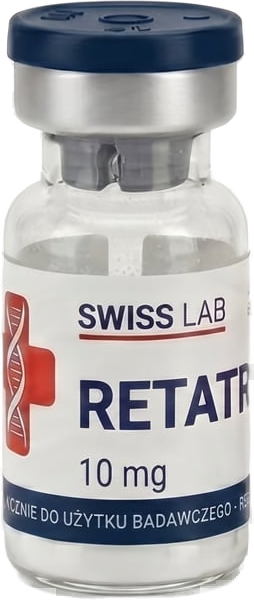
Retatrutide (research code LY3437943, developed by Eli Lilly) is the first molecule of a new type that simultaneously activates three “switches” (receptors) governing metabolism: GLP-1, GIP and the glucagon receptor. A receptor is a site on a cell that a given molecule fits like a key in a lock — once matched, it triggers a particular action in the cell. Online, retatrutide is sometimes called “GLP-3” or “triple G”, but those are marketing shorthand. The point is that one molecule acts on three pathways at once. It is the next step in the development of this whole drug class: from molecules acting on one pathway (semaglutide — GLP-1 alone), through two (tirzepatide — GLP-1 and GIP), to three at once in retatrutide.
Where retatrutide came from
The older drugs in this class mimic GLP-1 — the hormone released in the gut after a meal that produces satiety and helps release insulin (the hormone that lowers blood sugar). Tirzepatide added a second hormone, GIP, achieving a stronger effect. Retatrutide goes a step further and brings in a third, seemingly surprising element — glucagon.
Glucagon is associated chiefly with raising blood sugar, so adding it to a drug meant to help control body weight and blood sugar sounds like a contradiction. The point is that in the right, controlled amount glucagon drives the burning of energy and mobilises fat stores, while the simultaneous action of GLP-1 and GIP balances its effect on blood sugar. The molecule was designed so that these three actions work together in one stable compound.
The structure of the molecule and how long it acts
Retatrutide is a peptide built from 39 amino acids (amino acids are the elements proteins are made of) with a fatty acid molecule attached. That fatty “tail” binds to albumin — the blood's main transport protein — which makes the molecule act far longer: instead of being cleared quickly by the kidneys, it circulates bound to protein and is released gradually. It therefore persists in the body for about 6 days, which in trials allowed convenient once-weekly injection. It is the same “life-extension” approach for a molecule that earlier proved itself in semaglutide and tirzepatide.
Three receptors — a deliberately uneven profile
Interestingly, retatrutide does not activate all three receptors with equal strength. Compared with the natural hormones:
- GIP: about 8.9 times more strongly than natural GIP — this is the leading pathway.
- GLP-1: about 2.5 times more weakly than natural GLP-1.
- Glucagon: about 2.9 times more weakly than natural glucagon.
This imbalance is planned. The shift towards GIP, with glucagon action simultaneously restrained, is meant to give the strongest possible effect (weight loss, blood-sugar control) while preserving safety and good tolerability. It is precisely this careful balancing that makes retatrutide act powerfully while, despite the glucagon component, not worsening sugar control — indeed improving it.
What each of the three pathways does
The GLP-1 pathway is the foundation of the whole class: it helps release insulin when blood sugar is high, reduces appetite by acting on satiety centres in the brain, and slows gastric emptying so that fullness lasts longer after a meal.
The GIP pathway strengthens blood-sugar control and — as the research on tirzepatide and retatrutide indicates — improves gastrointestinal tolerability and adds to the effect on body weight. It also affects fat handling in adipose tissue.
The glucagon pathway is the element that sets retatrutide apart from every current drug of this kind — we devote a separate section to it below.
Glucagon — the secret of triple action
Activating the glucagon receptor sets off mechanisms that neither semaglutide nor tirzepatide has:
- Greater energy expenditure. Glucagon raises the rate at which the body burns energy — an effect on the “spending” side, not just on curbing appetite. Put visually: we do not only turn down the inflow of calories, we also open their outflow wider.
- Mobilising liver fat. Glucagon intensifies the breakdown of fat stored in the liver and — as the scientific literature describes — improves the working of liver cells' “power stations” (mitochondria). That probably explains retatrutide's very good results in fatty liver.
- An effect on amino acids. Glucagon lowers circulating amino acid levels, which — research suggests — also contributes to greater energy expenditure.
The net effect: the body takes in fewer calories (less appetite) and at the same time burns more of them (higher energy expenditure). In animal studies this translated into greater weight loss than with tirzepatide alone.
Why triple beats double and single
This is clearest when the trial results are set side by side. The comparison is indicative only (different trials, different groups of people — not a head-to-head comparison), but the scale of the differences is telling:
- Retatrutide 12 mg: about 24.2% weight loss over 48 weeks (phase 2 trial, obesity).
- Tirzepatide 15 mg: about 20.9% (the SURMOUNT-1 trial).
- Semaglutide 2.4 mg: about 14.9% over 68 weeks (the STEP 1 trial).
Retatrutide also came out ahead in analyses against other molecules under development, survodutide for instance (about 18.7%). The difference is not only quantitative but qualitative: adding the glucagon pathway and an energy-“burning” element clearly raises the ceiling of efficacy.
How this was studied structurally
How a single molecule fits three different receptors has been described in detail using a special method for imaging molecules at very low temperature (cryo-electron microscopy) in a paper published in Cell Discovery (2024). Such studies show how the individual parts of the molecule bind the three receptors — and that knowledge allows the next generations of similar drugs to be designed deliberately.
How retatrutide was given in the trials
In the trials retatrutide was given as a single subcutaneous injection once a week, regardless of meals — just like semaglutide and tirzepatide. Gradual dose escalation was important: treatment started at a low dose and was raised every few weeks. The reason is practical — the commonest adverse effects (nausea, diarrhoea) come from the GLP-1/GIP pathway and are milder the more slowly the body adapts to the drug. In the phase 2 trial, lowering the starting dose from 4 mg to 2 mg noticeably improved tolerability. That is why the rule in this drug class is “start low and go slow”.
Retatrutide's place among metabolic drugs
Retatrutide is best seen as the next stage in the rapid development of this whole class. The first generation consisted of drugs acting on one pathway — GLP-1 (semaglutide, for instance), which for the first time produced weight loss in the mid-teens of per cent. The second generation is a drug for two pathways — GLP-1 and GIP (tirzepatide), which raised the figure to about 20%. Retatrutide opens the third generation — action on three pathways with glucagon added, aiming at 25–30%. Other approaches are being developed in parallel (survodutide, for example, or the combination called CagriSema), but retatrutide was the first to unite all three receptors in one molecule. Work on the future includes oral forms and still finer tuning of the balance between pathways.
The question of muscle mass
With weight loss on this scale, a legitimate question arises about muscle loss. The glucagon pathway, by lowering amino acid levels and intensifying protein breakdown, could in theory favour muscle loss — an area under active investigation. Early data for similar molecules suggested that muscle loss remains moderate relative to total weight lost, but the definitive answer will come only from full body-composition studies in phase 3.
Summary
Retatrutide is not another “GLP-1 drug” but a new category: a molecule acting on three pathways that combines appetite reduction with greater energy expenditure and strong clearance of fat from the liver. How that mechanism translated into concrete results in people is described in our articles on the phase 2 trials and the phase 3 TRIUMPH programme. The broader context of the whole class of metabolic peptides is in GLP-1, GIP, glucagon — metabolic peptides in research.
Sources
- Jastreboff AM et al. (2023), Triple–Hormone-Receptor Agonist Retatrutide for Obesity — A Phase 2 Trial, New England Journal of Medicine — nejm.org
- Structural insights into the triple agonism at GLP-1R, GIPR and GCGR manifested by retatrutide (2024), Cell Discovery — nature.com
- Triple Agonism Based Therapies for Obesity (review), PMC — pmc.ncbi.nlm.nih.gov/articles/PMC12304053
For in-vitro laboratory research only. It is not a human medicine and is not for treatment.