
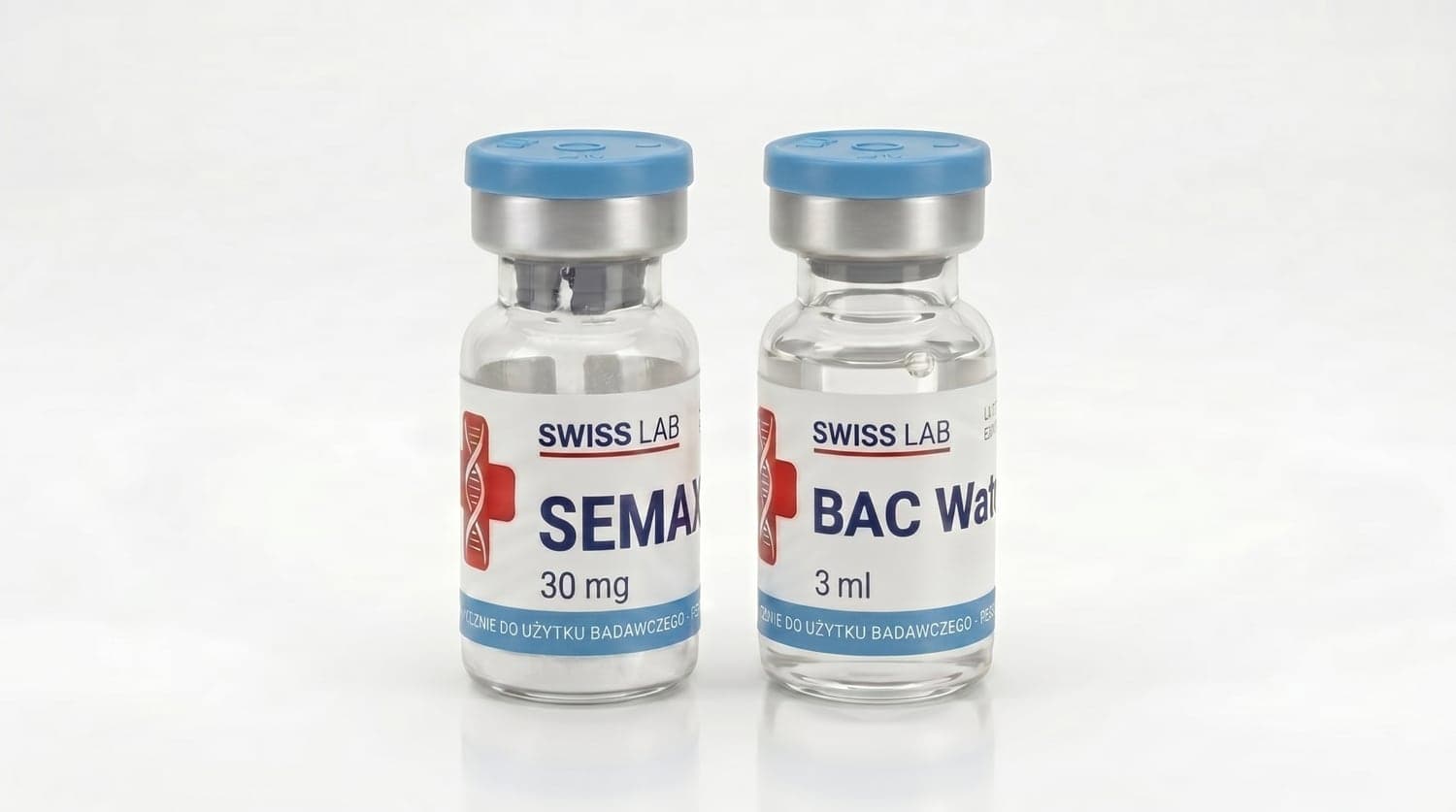
What Semax is
Semax is a peptide — a short chain of amino acids, the molecules proteins are built from — made synthetically in the laboratory. It was modelled on a fragment of one of the body's own hormones, but it no longer acts as a hormone itself.
A small tail was added to its structure, which makes the peptide more stable and slower to break down in the body. Semax is extensively described in the Russian scientific literature, where most of the work on it was done. Outside Russia the data are scarce, and most results come from animal studies.
It is often described as a compound that may protect the brain and support memory. A review of its properties is here: Semax in an Alzheimer's disease model (PMC).
How it works (in short)
The best-studied action of Semax is its effect on a protein called BDNF. This is a natural factor that helps nerve cells grow, survive and form new connections — which matters for learning and memory. In rat studies Semax raised the level of this protein in the brain.
This has been shown in several papers: Semax increases BDNF production in the rat brain (PubMed) and effects of Semax after cerebral ischaemia (PMC).
The peptide also affects inflammatory processes and may limit the death of nerve cells deprived of oxygen. It is thought to cross into the brain. These observations come mainly from animal and cell studies.
What is being studied
The most extensively studied area is protection of the brain during ischaemia — when too little blood reaches part of the brain, as in a stroke. Animal studies have examined whether the peptide helps protect and rebuild nerve tissue. This is described here: protective action of Semax in cerebral ischaemia (PMC).
A second direction is memory, attention and learning. Some data come from animal work, some from small experimental studies. Semax has also been examined in an animal model of Alzheimer's disease: Semax and memory impairment (PMC).
Despite many years of research in Russia, the international data are limited and preliminary. They come mainly from animal studies and do not support conclusions about efficacy in humans. Semax remains primarily an interesting object of scientific study.
For in-vitro laboratory research only. Not for human or animal consumption and not for treatment.