
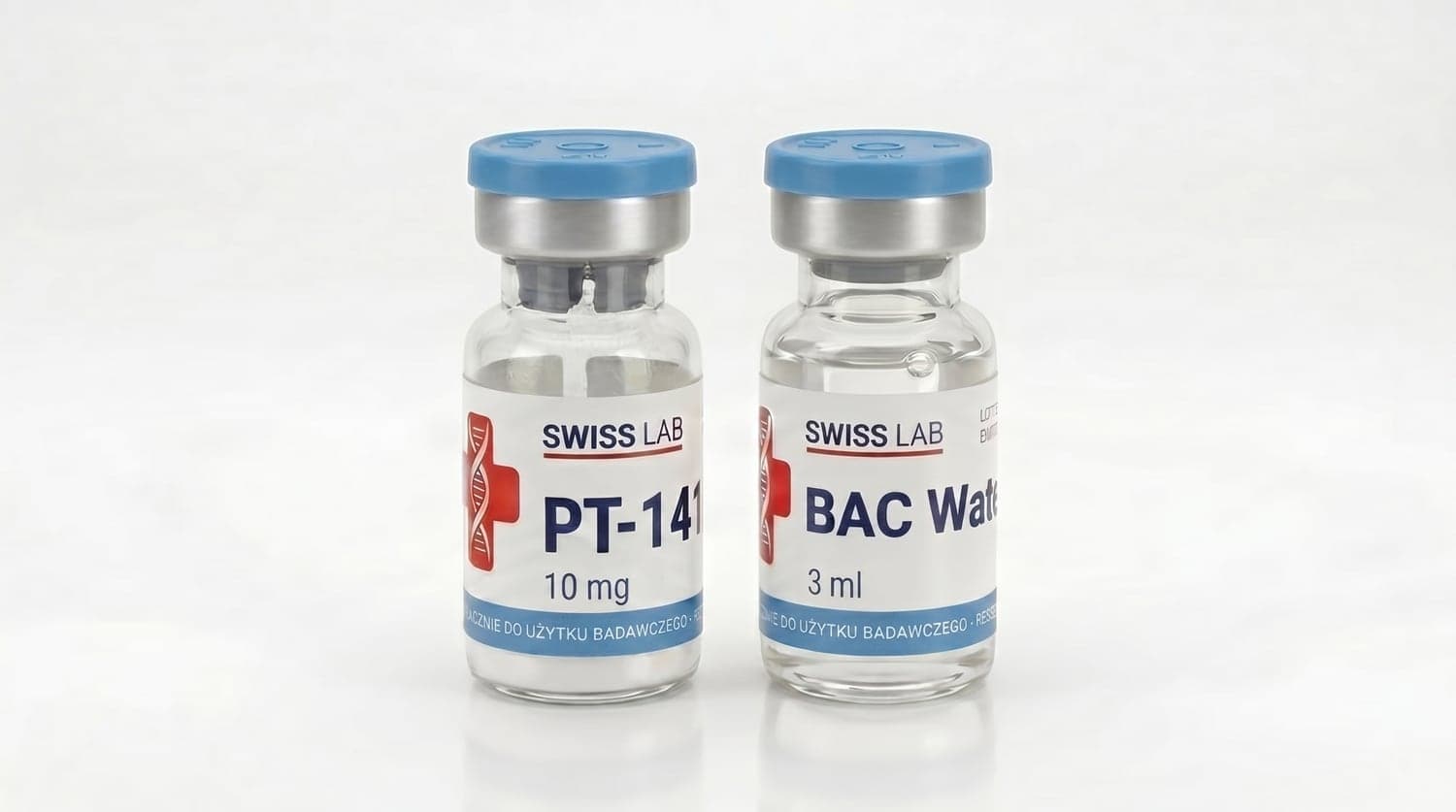
What PT-141 (bremelanotide) is
PT-141, or bremelanotide, is a synthetic peptide (a short chain of amino acids). It came out of reworking melanotan II. Researchers are interested mainly in how it acts on one particular receptor in the brain, designated MC4R.
It is one of the few peptides of this kind that has been approved as a medicine. In 2019 the US FDA authorised its use (trade name Vyleesi) in one narrow case — premenopausal women with reduced sexual desire. The NIH entry confirms this: LiverTox, NCBI (NIH).
In the laboratory PT-141 serves as a research tool for probing how this brain system, responsible for motivation and arousal, works.
How it works (in short)
PT-141 activates several hormone receptors at once, but its main action runs through the MC4R receptor in the brain. That sets it apart from erectile-function drugs (such as sildenafil), which act on blood vessels. PT-141 works from the brain side, not the vascular side.
Activating MC4R in the brain leads to the release of dopamine — the substance linked to motivation and wanting. A review describes this in more detail: review of bremelanotide (PMC).
Because the compound also acts on receptors outside the brain (in the skin, for instance), studies show incidental effects such as an influence on skin pigment.
What is being studied
The best evidence comes from two large controlled trials (named RECONNECT) testing efficacy and safety in premenopausal women with reduced desire. Results: phase 3 trials (PubMed). Beyond that single approved use, no other application has been officially confirmed.
Researchers also study this hormonal system more broadly in the context of appetite and reward mechanisms in the brain.
For safety reasons the effect on blood pressure has been examined too — a transient rise was observed: blood-pressure study (PMC). This shows that the wider properties of PT-141 need careful assessment.
For in-vitro laboratory research only. Not for human or animal consumption and not for treatment.