
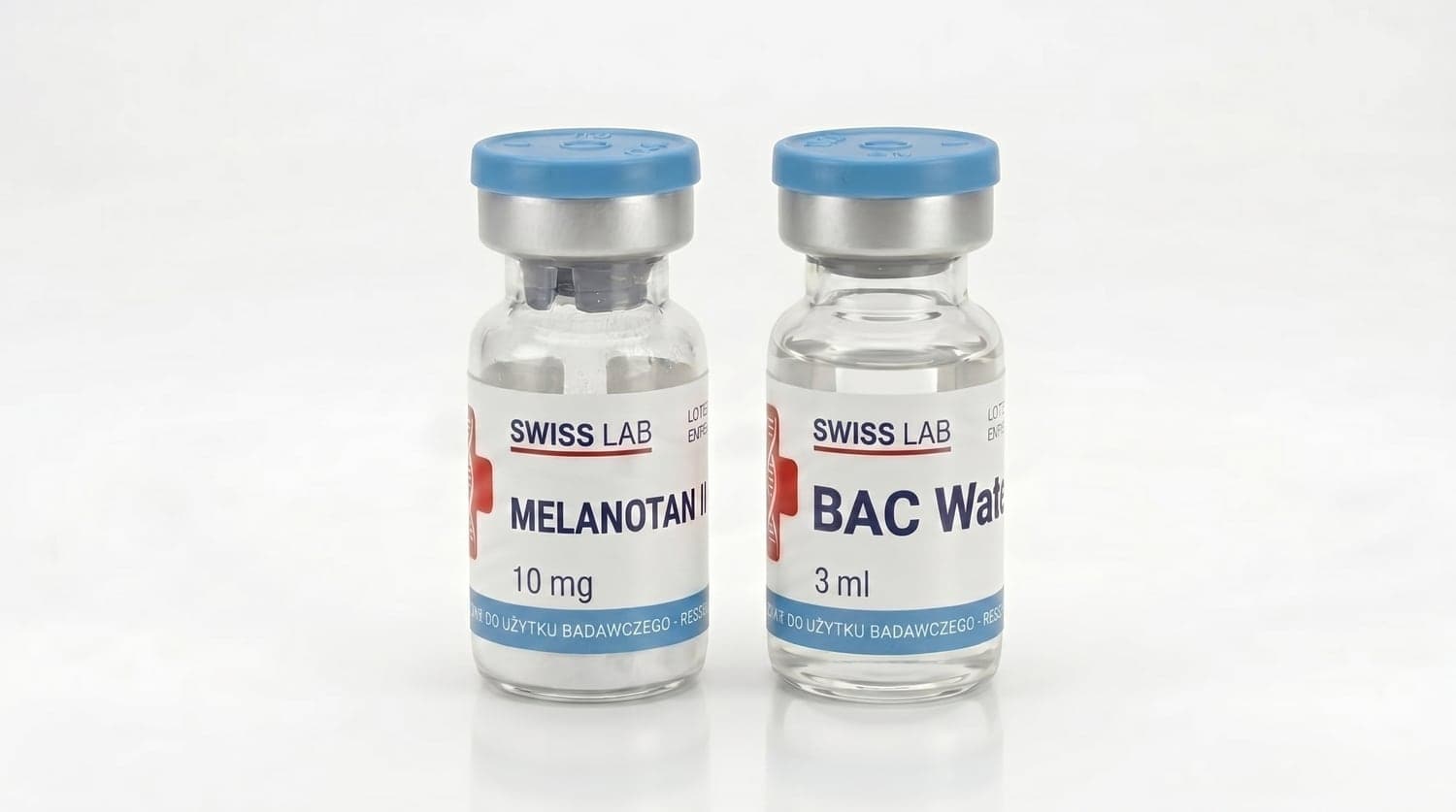
What Melanotan II is
Melanotan II (MT-II) is a synthetic peptide (a short chain of amino acids) built on the model of the natural hormone alpha-MSH — the hormone that prompts skin cells to produce pigment. The synthetic version is more stable and acts more strongly than the natural one.
MT-II activates several kinds of receptor in the body at once, not only those in the skin. That distinguishes it from more selective related compounds such as afamelanotide, which is studied in skin disorders. An overview of this family: afamelanotide review (PMC).
In research, MT-II is a valued tool for probing how this hormonal system works — in tanning, appetite and nervous-system function.
How it works (in short)
MT-II switches on hormone receptors in cells. The one that matters most for skin colour is the receptor called MC1R in pigment cells. Activating it increases production of the dark pigment (eumelanin) that shields skin from the sun. The role of this receptor is described here: study (PubMed).
That dark pigment is also somewhat protective against UV, which this review covers in more depth: review of skin pigments (PMC).
Because MT-II acts on many receptors at once, it also affects areas beyond the skin — appetite and sexual behaviour among them. That is why studies show mixed effects.
What is being studied
Animal studies have examined several directions, including the effect of MT-II on rat behaviour after stress: study (PubMed). A related compound (bremelanotide) has also been studied and was approved as a medicine for low sexual desire in women: paper (PubMed).
Data on MT-II itself in humans are very sparse. It is not an approved medicine and has not gone through full trials confirming safety and efficacy.
Reports have described side effects associated with MT-II, including: nausea, facial flushing, reduced appetite, yawning, erections, and darkening and proliferation of moles (naevi). The risk has not been fully characterised. This information is for knowledge only.
For in-vitro laboratory research only. Not for human or animal consumption and not for treatment.