
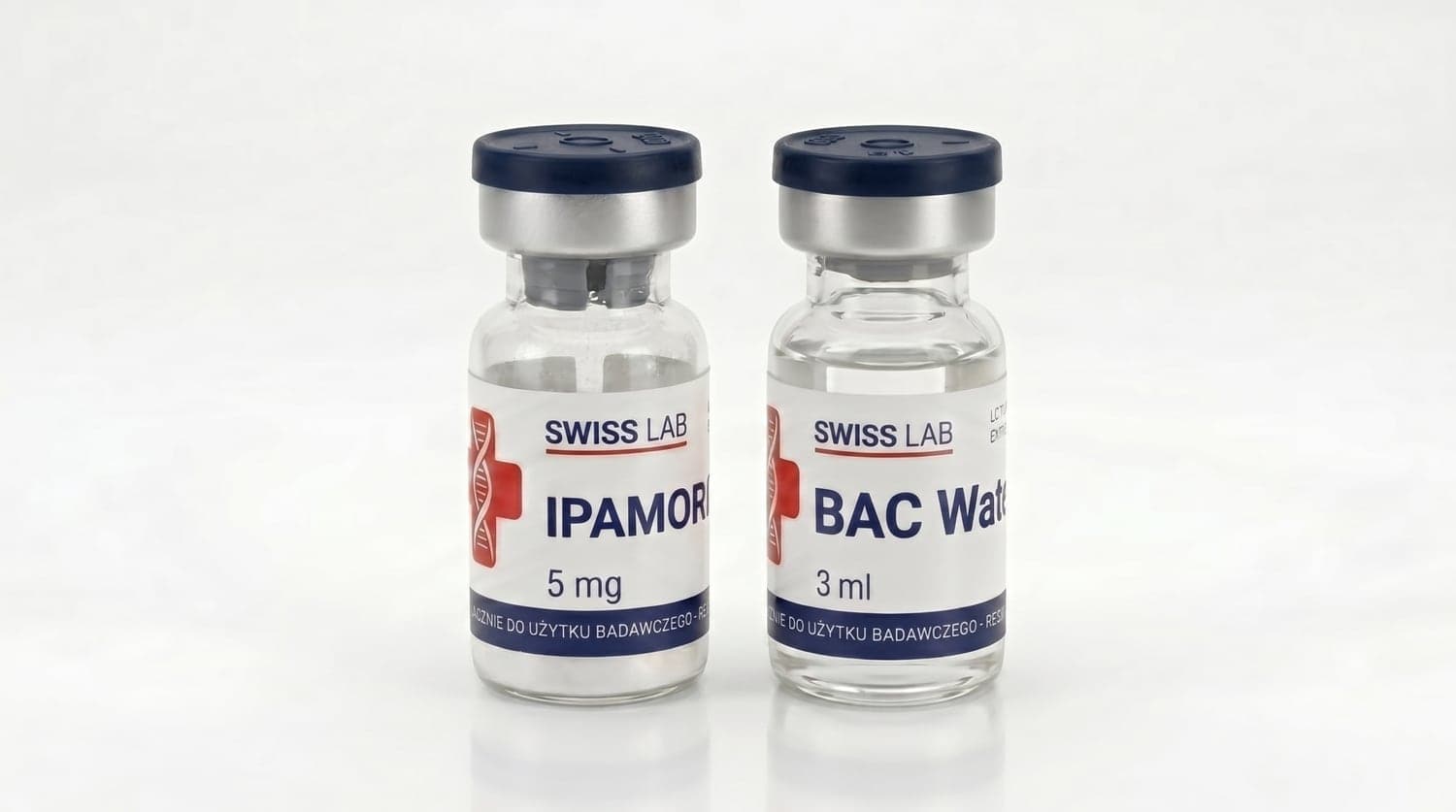
What ipamorelin is
Ipamorelin is a peptide — a short chain of amino acids (the building blocks of proteins). This one is very short: five such blocks. It is produced synthetically in the laboratory.
It belongs to the group of compounds that prompt the body to release its own growth hormone. It acts like the natural hormone ghrelin and activates the same receptor. The first description of the compound is in a 1998 paper (PubMed). It is related to other similar peptides, but in studies it moved growth hormone more selectively than they did — the comparison is described in the paper on peptides in this group (PubMed).
Important: what is known about ipamorelin comes mainly from cell and animal studies, not from large human trials. It is therefore treated primarily as laboratory research material.
How it works (in short)
An agonist is a molecule that presses the same switch in the body as the natural hormone. Ipamorelin presses the ghrelin switch (the receptor known as GHS-R1a). That is a signal to the pituitary — a small gland in the brain — to release a pulse of growth hormone. The biochemistry of this pathway is described in the review on ghrelin signalling (PMC).
What distinguishes ipamorelin in animal studies is selectivity: it stimulated growth-hormone release but — unlike related peptides — did not noticeably raise stress hormones such as cortisol. A comparison of such compounds is described in the paper on the ghrelin pathway (PMC). All of these data are laboratory findings and do not translate directly into effects in humans.
What is being studied
In science ipamorelin serves mainly as a tool for studying how the body regulates growth-hormone release. In animals the effects of prolonged administration have been examined — an example is the paper studying the compound in rats (PubMed).
A broader review of this class discusses the research directions under consideration, such as a possible effect on body composition, while noting that the data are scarce and further study is needed. That review is in the paper on growth-hormone secretagogue peptides (PMC). These are research hypotheses, not recommendations.
In short: the applications described are still at an early research stage. Conclusive data from large human trials are missing, so the compound should be treated purely as scientific research material.
For in-vitro laboratory research only. Not for human or animal consumption and not for treatment.