
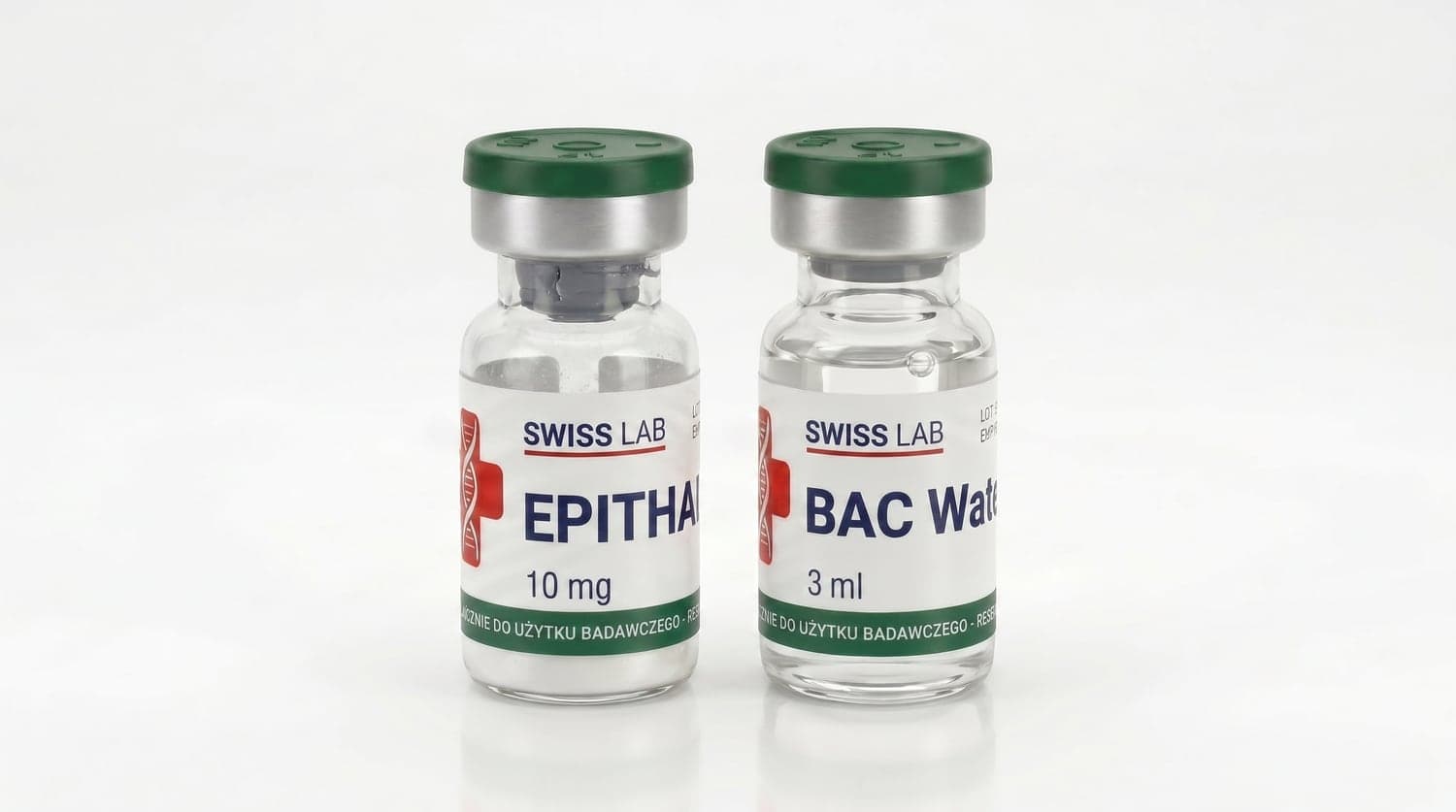
What epitalon is
Epitalon (also Epithalon or AEDG) is a synthetic peptide — a very short chain of four amino acids (the building blocks of proteins). It was developed in Russia in the 1980s and 1990s as a simplified version of an extract from the pineal gland, a small gland in the brain.
It is one of the best-studied peptides of its kind. Researchers are interested in it mainly in the context of ageing. It is worth knowing that a large part of the research was carried out by a single group, and independent confirmations have only begun to appear recently.
A review of what is known about the molecule today is here: review paper, 2025 (PMC).
How it works (in short)
It is most often said that Epitalon may stimulate telomerase — the enzyme that rebuilds the ends of chromosomes, known as telomeres. Telomeres shorten with age, so rebuilding them is studied as a possible lead in ageing research.
In one frequently cited study on cultured human cells, Epitalon increased the activity of that enzyme and lengthened telomeres, so the cells divided for longer: 2003 study (PubMed). Animal studies also observed effects on the pineal gland and melatonin production.
It must be stressed, however: these observations come from cells in culture and from animal studies. It has not been proven that it works the same way in the human body.
What is being studied
Epitalon is used above all as a research tool in work on ageing and telomeres. In animals, effects on lifespan and on the cell's natural defence mechanisms have been examined.
More recent cell studies confirm an effect on telomere length but note that it may act differently in healthy cells and in cancer cells: 2025 study (PMC).
Human evidence is still very scarce. Large independent controlled trials are missing, so every conclusion about efficacy in humans is preliminary for now.
For in-vitro laboratory research only. Not for human or animal consumption and not for treatment.