
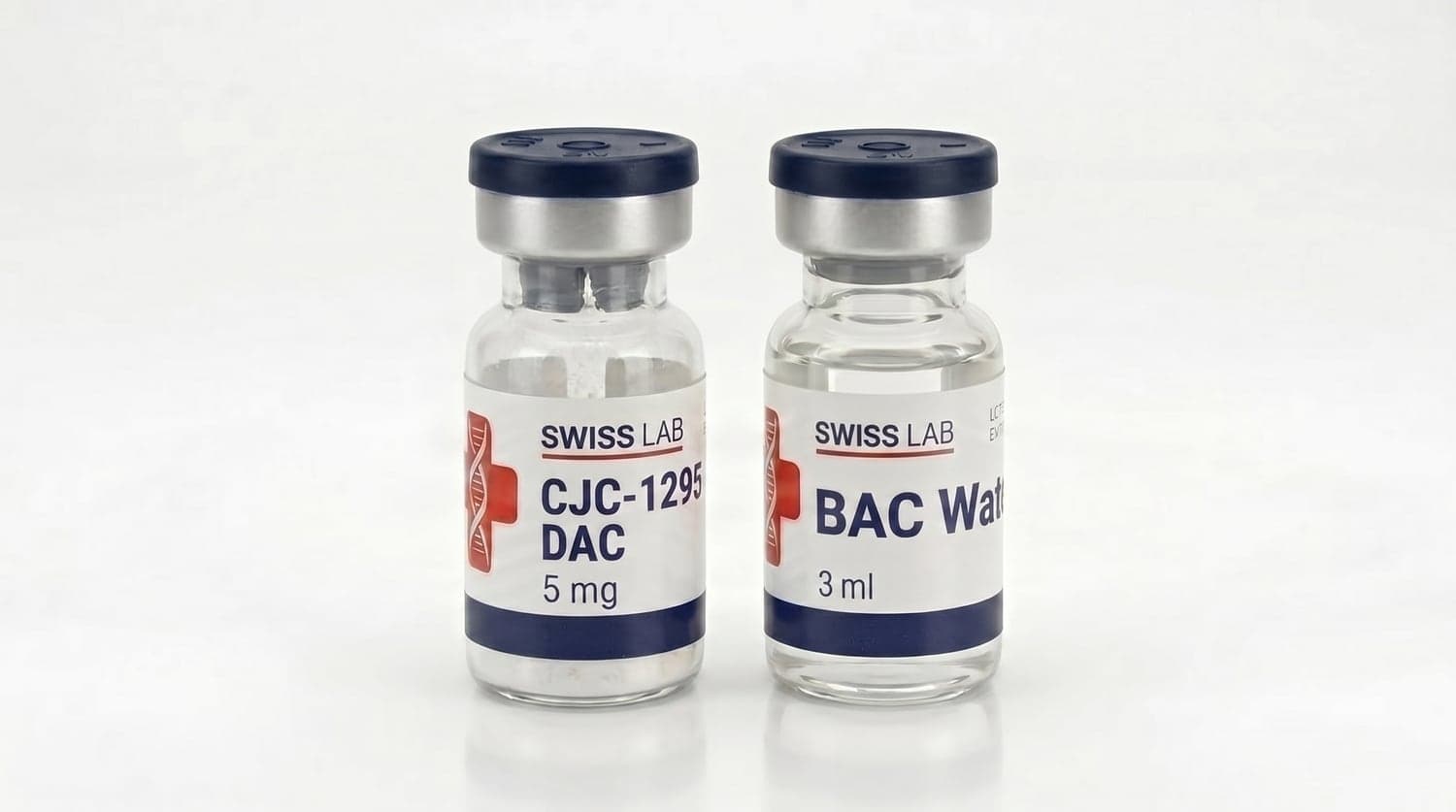
What CJC-1295 (DAC) is
CJC-1295 (DAC) is a synthetic peptide (a short chain of amino acids). It mimics the natural hormone GHRH — the signal that tells the pituitary (a small gland in the brain) to secrete growth hormone. The peptide was modified so the body breaks it down more slowly than the natural hormone.
Its key feature is an attached component called DAC. It makes the peptide bind durably to albumin, a protein circulating in the blood, so it persists in the body far longer than ordinary short-acting equivalents.
Human data are limited and come from small, early studies. A detailed account is here: 2006 study (PubMed).
How it works (in short)
CJC-1295 activates the same pituitary receptor as the natural hormone GHRH. That leads to the secretion of growth hormone (GH), which in turn tells the liver to produce another growth factor called IGF-1. The whole system is tightly regulated in the body. More on this: review paper, 2025 (PubMed).
Because it binds to albumin, the peptide persists not for minutes but for several days. That means it stimulates the body continuously rather than in bursts. In a study in healthy adults, a single dose raised GH and IGF-1 for many days: the same 2006 study (PubMed). The consequences of such prolonged, continuous action are still under investigation.
What is being studied
CJC-1295 (DAC) is used purely as a research tool for examining how the growth-hormone system works and how long-acting peptides of this type behave. What is measured most often is whether it durably raises GH and IGF-1.
In studies on mice lacking natural GHRH, giving CJC-1295 restored normal body mass and length, confirming that the peptide works: animal study, 2006 (PubMed).
Human data are scarce. Large long-term trials confirming efficacy and safety are missing. It therefore remains a research subject, not an approved agent.
For in-vitro laboratory research only. Not for human or animal consumption and not for treatment.