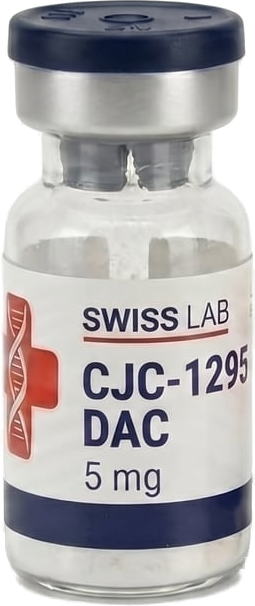
“CJC-1295 without DAC”, more often called Mod GRF 1-29, is a laboratory-made peptide (a short chain of amino acids) that is a reworked fragment of the natural hormone GHRH — the signal with which the brain tells the pituitary to release growth hormone. It differs from the plain GHRH fragment (sermorelin) by four amino-acid substitutions meant to protect it from breakdown. It differs from the “full” CJC-1295 by lacking the chemical hook (DAC) that binds the peptide to albumin and extends its action to days. The most important point of this review: we found not a single peer-reviewed human study of this exact compound. What is “known” about it is inferred from studies of the individual substitutions, from animals and — most misleadingly — from studies of CJC-1295 with DAC, a different molecule.
What Mod GRF 1-29 is, and why the name is confusing
The name CJC-1295 was given by the company ConjuChem of Montreal to one specific molecule: the GHRH(1-29) fragment with four amino-acid substitutions and a group attached at the end (a lysine maleimidopropionamide) which, after injection, binds permanently to albumin in the blood. That linker is the DAC. The paper by Jette et al. (2005) describes how, out of three such conjugates, CJC-1295 was selected as a stable analogue with an extended half-life. Remove the hook and what remains is the bare, four-fold modified 1-29 fragment — and that is Mod GRF 1-29. “CJC-1295 without DAC” is a trade name, not a scientific one; in the literature this peptide practically never appears under either name. It is not a medicine in any country.
How it is supposed to work
GHRH acts on a “switch” (a receptor) on cells of the pituitary — a small gland at the base of the brain — and triggers a burst of growth hormone (GH), which raises IGF-1. Mod GRF 1-29 is supposed to act just like sermorelin, only for longer, because enzymes cut it more slowly. By design it gives a single, brief GH pulse rather than the multi-day stimulation of the DAC version. This is, however, an expected description, not a measured one: the review by Dominikowski and colleagues (2026) states that claims about “physiological pulsatility” and effects on body composition come from extrapolation from related compounds (mainly sermorelin) and from non-academic sources.
Structure — why four substitutions
Each substitution has its rationale in the peptide chemistry of the 1980s and 1990s. Natural GHRH is cut in the blood by the enzyme DPP-IV between the 2nd and 3rd amino acids — Frohman et al. (1989) showed that this is the main route of breakdown and that a D-amino acid at position 1 or 2 blocks the cut; hence D-alanine at position 2. Campbell et al. (1994) described the remaining problems: the asparagine at position 8 spontaneously rearranges in aqueous solution (isomerisation), and the methionine at position 27 oxidises — both changes reduce activity. Replacing them with glutamine (8) and leucine (27) stabilises the molecule, and replacing glycine with alanine at position 15 improves receptor binding. Analogues substituted at the same positions (in Campbell's work with different residues at the start of the chain) were about three times more potent than natural GHRH in cultured rat pituitary cells, and 11–13 times more potent in pigs. The set D-Ala2, Gln8, Ala15, Leu27 is the peptide part of CJC-1295.
What was studied — cells and animals
The laboratory data concern the individual substitutions or the full CJC-1295. Campbell et al. (1994) confirmed in plasma in vitro that substitutions at the start of the chain block cleavage by DPP-IV for 24 hours. Jette et al. (2005) showed in rats that CJC-1295 (with DAC) gives a four-fold larger area under the GH curve over 2 hours than the unmodified 1-29 fragment and remains detectable in the blood beyond 72 hours. An important warning comes from Aitman et al. (1989): an analogue with D-alanine at position 2, “superactive” in the rat, produced the same GH burst in humans as the plain 1-29 fragment — the increased potency in rodents did not carry over to humans, probably because of receptor differences.
Human data — what is missing and what stands in its place
We searched PubMed for “modified GRF”, “mod GRF”, “CJC-1295 without DAC”, “tetrasubstituted GRF(1-29)” and “CJC-1295”, and the ClinicalTrials.gov registry. Result: zero human studies of Mod GRF 1-29. The registry holds one study of CJC-1295 (the DAC version, in people with HIV) — terminated. The 2026 review assigns the no-DAC version the lowest evidence tier (D: no peer-reviewed human studies). What exists instead: Soule et al. (1994) infused 10 healthy men with the plain 1-29 fragment and its version carrying only D-alanine at position 2 — the disappearance half-time from blood lengthened from 4.3 to 6.7 minutes and clearance halved. These are the only human data on any of the substitutions; the scale is minutes, not hours.
The most frequently cited “human studies of CJC-1295” are the papers by Teichman et al. (2006) and their follow-ups — they concern the version with DAC: after a single injection GH rose 2- to 10-fold for 6 or more days, IGF-1 1.5- to 3-fold for 9–11 days, and the half-life was 5.8–8.1 days. Those numbers cannot be transferred to Mod GRF 1-29, because they stem from albumin binding, which the no-DAC version lacks. More in a separate piece on CJC-1295.
Trade, doping and product identity
Although science is silent about it, Mod GRF 1-29 is in circulation. Gajda et al. (2019) analysed preparations seized by Danish customs and identified analogues of GHRP-2, GHRP-6, ipamorelin and “modified GRF 1-29” — but in every case with an extra glycine at the start of the chain, i.e. molecules other than those declared. The authors state plainly that these compounds can be used as performance-enhancing substances. The US FDA has placed CJC-1295 on its list of bulk substances for compounding that may present significant safety risks, citing reported serious events — increased heart rate and systemic vasodilatory reaction — and the risk of immunogenicity and impurities (FDA list); the entry does not distinguish the with-DAC and no-DAC versions.
Safety and the limits of the evidence
The safety of Mod GRF 1-29 in humans has not been studied — there are no data on tolerability, effects on glucose or long-term effects. By analogy with sermorelin one might expect facial flushing and injection-site pain, but that is a supposition. Any stimulation of the GH–IGF-1 axis carries theoretical, unstudied questions about the effect of a persistently raised IGF-1 on cancer risk (the 2026 review). Add the identity problem: grey-market preparations contained molecules other than those declared, so without a certificate of analysis it is not known what is in the vial. We deliberately give no methods of use and no doses — in this case there are not even studies from which they could be quoted.
The wider context — GHRH analogues
Mod GRF 1-29 sits between sermorelin (no substitutions, historically the medicine Geref) and CJC-1295 with DAC (substitutions plus the albumin hook, phase 1 human studies). The only GHRH analogue with phase 3 trials and an approval is tesamorelin. Online, Mod GRF 1-29 is often described as the “model partner” for ipamorelin, which acts through a different receptor (the ghrelin receptor); we found no human study of such a combination.
Summary
Mod GRF 1-29 is the GHRH(1-29) fragment with four chemically well-justified substitutions, the peptide part of CJC-1295 stripped of the DAC linker. The substitutions were studied in cells, in pigs and rats, and one of them (D-Ala2) in 10 men; the finished peptide itself has not a single peer-reviewed human study, and the most frequently quoted numbers belong to a different molecule — CJC-1295 with DAC. State of the evidence: no human data; everything beyond the chemistry is inference by analogy.
Sources
- Dominikowski A, Rękoś Z, Olejarz M, et al. The emerging landscape of performance-enhancing peptides modulating GH-IGF1 axis: bridging the gap between clinical evidence and patient self-administration. Frontiers in Endocrinology. 2026;17:1822475. PMID: 42395176. DOI: 10.3389/fendo.2026.1822475. pubmed.ncbi.nlm.nih.gov/42395176
- Jetté L, Léger R, Thibaudeau K, et al. Human growth hormone-releasing factor (hGRF)1-29-albumin bioconjugates activate the GRF receptor on the anterior pituitary in rats: identification of CJC-1295 as a long-lasting GRF analog. Endocrinology. 2005;146(7):3052–8. PMID: 15817669. DOI: 10.1210/en.2004-1286. pubmed.ncbi.nlm.nih.gov/15817669
- Teichman SL, Neale A, Lawrence B, et al. Prolonged stimulation of growth hormone (GH) and insulin-like growth factor I secretion by CJC-1295, a long-acting analog of GH-releasing hormone, in healthy adults. Journal of Clinical Endocrinology and Metabolism. 2006;91(3):799–805. PMID: 16352683. DOI: 10.1210/jc.2005-1536. pubmed.ncbi.nlm.nih.gov/16352683
- Campbell RM, Stricker P, Miller R, et al. Enhanced stability and potency of novel growth hormone-releasing factor (GRF) analogues derived from rodent and human GRF sequences. Peptides. 1994;15(3):489–95. PMID: 7937325. DOI: 10.1016/0196-9781(94)90211-9. pubmed.ncbi.nlm.nih.gov/7937325
- Frohman LA, Downs TR, Heimer EP, Felix AM. Dipeptidylpeptidase IV and trypsin-like enzymatic degradation of human growth hormone-releasing hormone in plasma. Journal of Clinical Investigation. 1989;83(5):1533–40. PMID: 2565342. DOI: 10.1172/JCI114049. pubmed.ncbi.nlm.nih.gov/2565342
- Soule S, King JA, Millar RP. Incorporation of D-Ala2 in growth hormone-releasing hormone-(1-29)-NH2 increases the half-life and decreases metabolic clearance in normal men. Journal of Clinical Endocrinology and Metabolism. 1994;79(4):1208–11. PMID: 7962295. DOI: 10.1210/jcem.79.4.7962295. pubmed.ncbi.nlm.nih.gov/7962295
- Aitman TJ, Rafferty B, Coy D, et al. Bioactivity of growth hormone releasing hormone (1-29) analogues after SC injection in man. Peptides. 1989;10(1):1–4. PMID: 2546126. DOI: 10.1016/0196-9781(89)90065-x. pubmed.ncbi.nlm.nih.gov/2546126
- Gajda PM, Holm NB, Hoej LJ, et al. Glycine-modified growth hormone secretagogues identified in seized doping material. Drug Testing and Analysis. 2019;11(2):350–354. PMID: 30136411. DOI: 10.1002/dta.2489. pubmed.ncbi.nlm.nih.gov/30136411
For in-vitro laboratory research only. It is not a human medicine and is not for treatment.