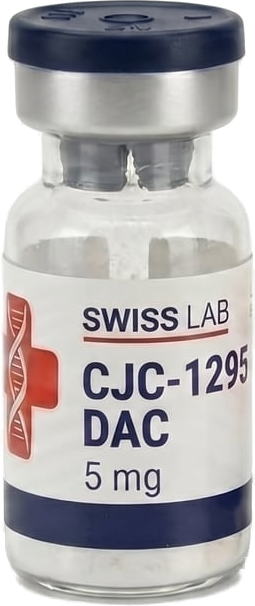
CJC-1295 is a synthetic molecule resembling the natural hormone GHRH (short for growth-hormone-releasing hormone — the hormone that tells the body to produce growth hormone). In scientific research it was studied mainly as a way of stimulating the body to produce growth hormone over a long period. A great many simplifications about it circulate online, so here we separate what genuinely follows from the research from the marketing promises. We are also honest about what is still not known.
What CJC-1295 is
CJC-1295 is a modified fragment of the human hormone GHRH. Researchers took the key active part of that hormone and introduced a few small changes that make the molecule break down more slowly in the body. In one version (“with DAC”) an element was also added that lets it bind durably to one of the blood proteins. The molecule was developed by ConjuChem in Montreal and described in a peer-reviewed scientific journal in 2005.
The legal context matters: CJC-1295 is not an approved medicine. It is a research substance. By comparison, a related molecule called tesamorelin went through full clinical trials and was approved by the US FDA (in 2010) for reducing excess abdominal fat in a particular group of patients. That shows molecules of this family can genuinely work, but each one requires its own rigorous trials.
How the body produces growth hormone
To understand CJC-1295 it helps to know the route by which growth hormone is produced. GHRH is secreted in the brain (in the hypothalamus) and prompts the pituitary — a small gland at the base of the brain — to produce and release growth hormone (GH). An opposing hormone, somatostatin, also acts, inhibiting growth-hormone release. From this “accelerator and brake” interplay follows an important feature: growth hormone is released in waves (in pulses), and the largest surges fall in the second half of the night, during deep sleep.
Growth hormone acts partly on its own and partly through another compound — IGF-1 (insulin-like growth factor), produced mainly in the liver under the influence of growth hormone. IGF-1 accounts for many of growth hormone's effects, but it also acts as a brake: when there is a lot of it, it sends a feedback signal telling the body to slow growth-hormone production. This self-regulation matters — molecules like CJC-1295 act at the “start” of this route and in principle preserve the natural control mechanisms, unlike giving growth hormone itself from outside.
The structure of the molecule and DAC technology
The most distinctive element of CJC-1295 is DAC — a chemical approach meant to greatly extend the molecule's duration of action. The natural hormone GHRH and its short fragment are broken down in the body almost instantly (partly by a particular enzyme) and disappear from the blood within minutes.
In the DAC version a special chemical “hook” was attached to the molecule. After injection that hook binds durably to albumin — the most abundant blood protein. Because albumin circulates in the blood for many days, the molecule attached to it also stays in the body far longer and is shielded from breakdown. The original 2005 paper showed that the conjugated molecule is more resistant to breakdown and still active — it stimulated growth-hormone release in cultured rat pituitary cells. CJC-1295 produced an effect roughly four times stronger than the unmodified fragment and was detectable in the blood even after more than 72 hours.
How CJC-1295 works
CJC-1295 works just as natural GHRH does: it binds the same receptor on pituitary cells and stimulates them to release growth hormone, which in turn raises IGF-1. The difference therefore lies not in a “new” mechanism but in how long the molecule persists in the body and stimulates the receptor.
That distinction is important. The short-acting version mimics the natural, brief pulse. The DAC version, by contrast, provides prolonged, continuous stimulation. Even with such continuous action, growth-hormone release remains pulsatile to a degree, because somatostatin also shapes its rhythm. Nevertheless, long, multi-day stimulation differs qualitatively from short, natural pulses — and it is precisely that difference that raises the most questions about safety with prolonged use.
Two versions: with DAC and without
In research practice and in everyday language the name “CJC-1295” refers to two different molecules, which is a common source of confusion:
- CJC-1295 with DAC — the full molecule with the “hook” binding it to albumin. According to human studies it persists in the body for about 6–8 days. In theory this allows infrequent dosing and keeps growth hormone and IGF-1 elevated for many days.
- CJC-1295 without DAC — commonly “mod GRF 1-29”. The same peptide part, but without the albumin-binding element. It persists in the body for only tens of minutes, and the rise in growth hormone is short-lived and closer to a natural pulse. In this respect it resembles another molecule called sermorelin.
This difference is significant. The non-DAC version reproduces a short signal and does not produce multi-day continuous stimulation. The DAC version means far longer action — which matters when thinking about the possible risks (discussed below). When speaking of “CJC-1295”, it is always worth specifying which version is meant.
What was actually studied in humans
The most important and most frequently cited human evidence is the paper by Teichman and colleagues (2006). It was an early clinical study (phase 1): two carefully designed placebo-controlled trials (with a group receiving an inert injection) using ascending doses. Healthy adult volunteers aged 21–61 took part.
The key results were:
- After a single injection of CJC-1295, growth-hormone levels rose 2- to 10-fold relative to baseline — the more so the higher the dose — and remained elevated for 6 days or longer.
- IGF-1 rose 1.5- to 3-fold and stayed elevated for 9–11 days after a single dose, and with repeated dosing for up to about 28 days.
- The molecule persisted in the body for about 6–8 days, confirming that the DAC technology works.
- The pulsatile character of growth-hormone release was largely preserved.
- The study recorded no serious adverse effects; the molecule was described as relatively well tolerated.
This is real data from a peer-reviewed human study — which is why CJC-1295 is taken more seriously in science than many other “internet peptides”. Proportion is needed, though: it was phase 1, an early stage assessing mainly the molecule's behaviour in the body and preliminary safety in a small group of healthy people. These are not studies confirming efficacy in treating any disease.
Safety and the limits of the evidence
An honest assessment requires separating what is known from what is not. We know that in early human studies CJC-1295 with DAC produced a sustained rise in growth hormone and IGF-1 and was preliminarily well tolerated. We know practically nothing, however, about its safety and efficacy over many months or years — because such large studies for this molecule simply do not exist.
The key limitations and possible risks to bear in mind:
- No large trials of efficacy and long-term safety. The available data are largely from an early research stage.
- Prolonged elevation of growth hormone and IGF-1. Doctors regard persistently high levels of these with caution — they are associated with the effects known from growth-hormone excess (fluid retention, joint pain and effects on blood sugar, for instance). Continuous stimulation with the DAC version raises more questions here than the short-acting non-DAC version.
- The quality of research material. The purity and composition of preparations from outside the controlled pharmaceutical supply chain can be uncertain — which is why a certificate of analysis (a document confirming composition) matters.
- Intended for research only. The substance is intended for research, not for use in humans.
For these reasons we deliberately give no doses or “self-treatment” schedules here. Such information has no basis in the official research and lies outside the bounds of sound scientific discussion.
CJC-1295 in the context of other molecules
CJC-1295 is best understood against the wider family of substances that prompt the body to produce its own growth hormone rather than supplying it from outside. They act in two main ways:
- GHRH-like molecules (such as CJC-1295, sermorelin, tesamorelin) — they activate the GHRH receptor in the pituitary.
- Ghrelin-mimicking molecules (such as ipamorelin) — they act through a different receptor and stimulate growth hormone by another mechanism.
Science often discusses both groups together, since they act on different receptors and are sometimes studied jointly. If the second group interests you, see our separate piece on ipamorelin. It is important not to treat “stimulating your own growth hormone” as automatically safe, though — prolonged, unnatural elevation of its level raises the same questions whichever receptor is used to trigger it.
Summary
CJC-1295 is a synthetic molecule resembling GHRH whose distinguishing feature is DAC technology — durable binding to albumin that extends its action from minutes to several days. It works as natural GHRH does (stimulating the pituitary to release growth hormone, which raises IGF-1), but it does so over a long period, which sets it apart from the short-acting non-DAC version. The best human evidence remains the phase 1 study by Teichman and colleagues (2006), which showed a sustained rise in growth hormone and IGF-1 and preliminary good tolerability in healthy volunteers. That is solid but early and limited data: large trials of efficacy and long-term safety are missing. CJC-1295 should therefore be treated as an interesting object of scientific research, not a proven therapy.
Sources
- Teichman SL, Neale A, Lawrence B, Gagnon C, Castaigne JP, Frohman LA. Prolonged stimulation of growth hormone (GH) and insulin-like growth factor I secretion by CJC-1295, a long-acting analog of GH-releasing hormone, in healthy adults. J Clin Endocrinol Metab. 2006;91(3):799-805. PMID: 16352683 (DOI: 10.1210/jc.2005-1536).
- Jetté L, Léger R, Thibaudeau K, et al. Human growth hormone-releasing factor (hGRF)1-29-albumin bioconjugates activate the GRF receptor on the anterior pituitary in rats: identification of CJC-1295 as a long-lasting GRF analog. Endocrinology. 2005;146(7):3052-3058. PMID: 15817669 (DOI: 10.1210/en.2004-1286).
- Melmed S, et al. (eds). Normal Physiology of Growth Hormone in Adults. Endotext. NCBI Bookshelf. NBK279056.
- Tesamorelin. LiverTox: Clinical and Research Information on Drug-Induced Liver Injury. NCBI Bookshelf, NIH. NBK548730.
For in-vitro laboratory research only. It is not a human medicine and is not for treatment.