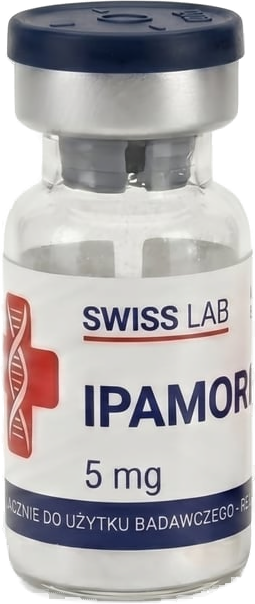
Ipamorelin is a laboratory-made peptide (a short chain of amino acids) described in the late 1990s. It was called the first “selective growth-hormone secretagogue” — a compound that prompts the body to release growth hormone (GH for short) while barely touching other hormones. It does this by mimicking a natural molecule called ghrelin. In this review we explain in plain terms what ipamorelin is, how it is meant to work and how strong the evidence is — and most of it comes from animal studies, supplemented by a few human studies on bowel function.
What ipamorelin is
Ipamorelin was developed by researchers at the Danish company Novo Nordisk and described in a paper by Raun's team in 1998. It came from reworking older, similar peptides — a small fragment was removed from their middle. The result is a short, entirely synthetic peptide that in studies strongly and — crucially — selectively stimulated growth-hormone release.
Ghrelin and its “switch” (the receptor)
To understand ipamorelin you need to know about ghrelin. Ghrelin is a natural hormone secreted mainly by the stomach. It acts on a certain “switch” on cells (the ghrelin receptor). When that switch is activated in the pituitary (a small gland in the brain), growth hormone is released; in the digestive tract it stimulates appetite and gut motility. Ipamorelin acts on the same switch — it mimics part of ghrelin's action, which is why it is called a “ghrelin mimetic”.
The structure of the peptide
Ipamorelin is a short peptide built from five amino acids, some of which have an unusual chemical structure. Those unusual elements make the molecule more resistant to breakdown in the body than ordinary natural peptides. This short, “reinforced” structure explains why it was studied as a stable compound acting on the ghrelin switch.
How it works and why it is selective
In animal studies ipamorelin strongly stimulated growth-hormone release. What mattered most, though, was something else: its selectivity. Even at doses more than 200 times higher than the one needed to release growth hormone, ipamorelin practically did not raise the stress hormone (cortisol) or another hormone (prolactin). That set it apart from older compounds, which also stimulated those additional hormones along the way. Hence its description as “the first selective growth-hormone secretagogue”.
Comparison with GHRP-2 and GHRP-6
The older peptides in this family — GHRP-6 and GHRP-2 — also strongly stimulate growth-hormone release through the same switch, but they raise other hormones in the process (cortisol, prolactin), and GHRP-6 additionally increases appetite sharply. Ipamorelin, though derived from them, stood out in studies precisely because it barely moved those additional hormones — that is its main characteristic in the literature. It must be stressed that these comparisons rest largely on animal work and limited data.
What was studied — animals
Beyond its effect on growth hormone, ipamorelin was also studied for its action on the gut, since it acts on the ghrelin switch. In a rodent model of bowel shutdown after surgery (Venkova et al., 2009) a single dose shortened the time to first bowel movement, and repeated doses increased faecal output, food intake and body-weight gain. These results indicated that the compound can stimulate gut motility under experimental conditions, and encouraged further research.
Human data — bowel function
The best-studied direction in humans is not growth hormone but bowel function. In a study by Beck et al. (2014) ipamorelin was tested in patients after bowel surgery — a proper blinded, placebo-controlled study, though exploratory in character. It enrolled 114 people who received intravenous ipamorelin or inactive placebo after surgery. The study was designed to assess safety and a first signal of efficacy in postoperative bowel shutdown. It is one of the few genuine human studies with this peptide; its results should be treated as preliminary, not as confirmation of efficacy.
Safety and the limits of the evidence
Most of what is known about ipamorelin comes from cell and animal studies and from single, early human studies on bowel function. Ipamorelin is not an approved medicine and has not gone through the full research path leading to marketing authorisation. That means its long-term safety and real efficacy in humans remain unestablished. The fact that it barely moved cortisol and prolactin in studies does not mean it is confirmed as safe in people. We deliberately give no methods of use and no doses.
The wider context — growth-hormone secretagogues
Ipamorelin belongs to a broader group of compounds that stimulate growth hormone through the ghrelin switch (alongside GHRP-2, GHRP-6 and hexarelin). This mode of action differs from another group acting on a separate switch (the GHRH receptor) — if you are interested, see our piece on the GHRH analogue CJC-1295. In the literature both groups are discussed together as research tools.
Summary
Ipamorelin is a short ghrelin-mimicking peptide, historically described as the first selective growth-hormone secretagogue — it stimulates GH release while barely touching cortisol and prolactin in animal studies. The most concrete human data concern not growth hormone but bowel function after surgery, where one exploratory study has been carried out. The evidence as a whole remains limited and largely from animal work. The ipamorelin supplied by SWISS LAB is a reagent intended for research use only.
Sources
- Raun K, Hansen BS, Johansen NL, et al. Ipamorelin, the first selective growth hormone secretagogue. European Journal of Endocrinology. 1998;139(5):552–561. PMID: 9849822. pubmed.ncbi.nlm.nih.gov/9849822
- Venkova K, Mann W, Nelson R, Greenwood-Van Meerveld B. Efficacy of ipamorelin, a novel ghrelin mimetic, in a rodent model of postoperative ileus. Journal of Pharmacology and Experimental Therapeutics. 2009;329(3):1110–1116. PMID: 19289567. pubmed.ncbi.nlm.nih.gov/19289567
- Beck DE, Sweeney WB, McCarter MD; Ipamorelin 201 Study Group. Prospective, randomized, controlled, proof-of-concept study of the Ghrelin mimetic ipamorelin for the management of postoperative ileus in bowel resection patients. International Journal of Colorectal Disease. 2014;29(12):1527–1534. PMID: 25331030. DOI: 10.1007/s00384-014-2030-8. pubmed.ncbi.nlm.nih.gov/25331030
- Ishida J, Saitoh M, Ebner N, et al. Growth hormone secretagogues: history, mechanism of action, and clinical development. JCSM Rapid Communications. 2020;3(1):25–37. DOI: 10.1002/rco2.9. onlinelibrary.wiley.com/doi/full/10.1002/rco2.9
For in-vitro laboratory research only. It is not a human medicine and is not for treatment.