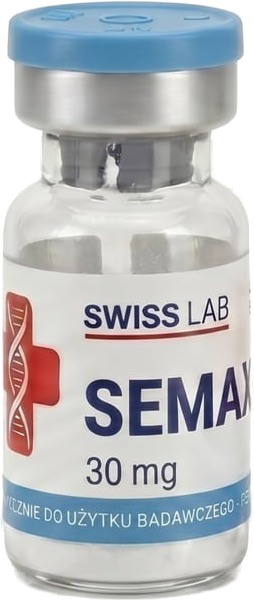
Semax is a synthetic peptide (a short chain of amino acids, the building blocks of proteins) classed among agents that support brain function and protect nerve cells. It was developed at Russian research institutes. Its structure is based on a fragment of a certain hormone, but the hormonal action itself was deliberately removed. The text below sets out what reputable scientific publications say about Semax — from the structure of the molecule, through the mechanisms studied, to an honest assessment of how much evidence there is and where it comes from. This is an informational review of a research substance, not health advice and not an encouragement to use it.
What Semax is and where it comes from
Semax is a peptide built from seven amino acids. It came about as a reworking of a fragment of the hormone ACTH (the hormone that stimulates the adrenal glands). The developers' key aim was to keep those features of the fragment that concern the brain (effects on nerve cells and on learning) while removing the hormonal action typical of the whole hormone.
The peptide was developed in the Soviet Union and then in Russia — mainly at institutes connected with the Russian Academy of Sciences and Moscow University. In Russia Semax was registered as a medicine (in conditions related to cerebral ischaemia, among others), which is important context when assessing the origin of the evidence — we return to this below.
Structure: a hormone core and a stabilising “tail”
The Semax molecule can be divided into two parts with different roles. The first is a core derived from the hormone ACTH, responsible for the action on nerve cells. The second is a short fragment attached at the end, made of three amino acids — proline, glycine and proline (PGP for short).
That three-amino-acid fragment is not merely a passive “tail” — the literature describes it as an element increasing the molecule's resistance to peptide-degrading enzymes, which lengthens its duration of action. What is more, review papers note that this fragment may have its own action in nerve tissue, so it is sometimes treated as a co-contributor to the effect rather than just a stabiliser. A molecule built this way is usually given intranasally in studies.
The action studied: nerve-nourishing proteins
The best-documented line of Semax research is its effect on nerve-nourishing proteins — proteins that regulate the survival, growth and plasticity of nerve cells. The two most often named are BDNF (the brain's nourishing protein) and NGF (nerve growth factor).
A study in rats showed that a single dose of Semax led to an increase in BDNF protein and activation of its receptor in the hippocampus (a brain region important for memory), as well as increased production of that protein. The authors regarded this as an effect on the BDNF system, linking it to the improvement in learning they observed (Dolotov and colleagues, Brain Research, 2006).
Another paper compared how the activity of the NGF and BDNF genes changes after Semax in different parts of the brain and in the retina. The changes turned out to be bidirectional and dependent on region and timing — in some places and at some moments activity rose, in others it briefly fell (Shadrina and colleagues, Journal of Molecular Neuroscience, 2010). That is an important detail: “raising BDNF/NGF” is not a uniform effect but a complex one.
Effects on dopamine and serotonin
Beyond the nourishing proteins, Semax's effect on dopamine and serotonin was also studied — the substances that carry signals between nerve cells and matter for mood and motivation among other things. A rodent paper described Semax affecting the serotonin system and enhancing dopamine release together with the associated behavioural response (Eremin and colleagues, Neurochemical Research, 2005). This suggests that alongside effects on nourishing proteins, signalling mechanisms may be involved — though these are less well understood and need further study.
Brain protection in experimental studies
Semax is described among peptides credited with limiting damage to nerve cells — excessive excitation, inflammation and cell death in injured tissue. In a rat model of cerebral ischaemia (cutting off blood supply and then restoring it), protein analysis showed that Semax affected signals related to the injury response: inhibition of pathways leading to cell death and activation of repair mechanisms were described, and in the area next to the injury a reduction in inflammatory markers (Sudarkina and colleagues, International Journal of Molecular Sciences, 2021).
Studies of this kind suggest a two-way action: limiting acute damage and supporting repair. They should be read as results from animal and cell models, however, not as proof of efficacy in humans.
Research on ischaemic stroke
In Russia, Semax is used and studied in conditions related to cerebral ischaemia, including ischaemic stroke, and it is this area that is often cited as the flagship example of its potential. In review papers on brain-protective peptides in stroke, Semax is listed as one of the synthetic peptides mimicking natural regulatory peptides (Dergunova and colleagues, Genes, 2023).
Caution is needed, though. Some of the available human data come from studies conducted in Russia which are sometimes designed without random allocation of participants and without a placebo comparison group (an inert substance) — which greatly weakens the conclusions. Semax is not approved by the American FDA or the European EMA, and independent Western replications of these results are few. In other words: there are indications and plausible mechanisms, but no solid, independently confirmed human evidence base meeting Western standards.
Memory and attention
Semax is often described as a compound with “nootropic” action, that is, studied for its effect on learning, memory and attention. Papers linking it to BDNF in the hippocampus (Dolotov and colleagues, 2006) give such hypotheses a biological rationale, since BDNF is central to the plasticity of nerve connections and the consolidation of memory.
A plausible mechanism must be distinguished from a proven effect in humans, though. Most of the data on memory and attention come from animal models or small, poorly designed studies. Similar “Russian research peptides” — such as the anxiolytic Selank — are discussed in the same way; interested readers can see our separate piece: Selank — the anti-anxiety peptide in the research.
Modified variants and molecular stability
Variants of Semax with a modified start of the molecule remain a research topic. Such a chemical change (adding an acetyl group at the beginning of the chain) is meant to alter the peptide's susceptibility to breakdown and potentially lengthen its action. It is considered in studies as a way of increasing the molecule's stability.
The Semax core is already designed for stability thanks to the terminal proline-glycine-proline fragment, so changes at the start of the molecule are treated as a further, experimental line of improvement. There is little data on these variants, however, and it is very early-stage — they should not be confused with well-characterised compounds.
Limits of the evidence base
An honest assessment of Semax requires several limitations to be stated clearly. First, a substantial share of the research comes from Russia, often from institutes connected with the peptide's originators, and independent Western replications are few. Second, much of the data comes from cell and rodent studies, which do not translate automatically to people. Third, the available human data are sometimes designed without random allocation and without placebo, which makes it hard to separate a real effect from expectation.
Fourth, the legal position is unambiguous: Semax is not approved as a medicine by Western regulators (FDA, EMA). Outside pharmacies it functions as a research reagent, not a medicine. These qualifications do not negate the scientific value of the work done so far, but they mark the limits of what can responsibly be claimed on its basis.
Summary
Semax is a synthetic brain-support peptide derived from a fragment of the hormone ACTH, extended with a stabilising terminal fragment and stripped of hormonal action. The best-documented line of research concerns its effect on nerve-nourishing proteins (BDNF, NGF) and the signals associated with them, and protective effects on the brain were described in ischaemia models. At the same time the evidence base has significant limitations: a predominance of Russian studies, a predominance of cell and animal data, weak independent replication and no approval in Western countries. Semax therefore remains an interesting object of scientific research rather than a proven therapeutic agent.
Sources
- Dolotov OV, Karpenko EA, Inozemtseva LS, et al. Semax, an analog of ACTH(4-10) with cognitive effects, regulates BDNF and trkB expression in the rat hippocampus. Brain Research. 2006;1117(1):54–60.
- Shadrina M, Kolomin T, Agapova T, et al. Comparison of the temporary dynamics of NGF and BDNF gene expression in rat hippocampus, frontal cortex, and retina under Semax action. Journal of Molecular Neuroscience. 2010;41(1):30–35.
- Eremin KO, Kudrin VS, Saransaari P, et al. Semax, an ACTH(4-10) analogue with nootropic properties, activates dopaminergic and serotoninergic brain systems in rodents. Neurochemical Research. 2005;30(12):1493–1500.
- Sudarkina OY, Filippenkov IB, Stavchansky VV, et al. Brain Protein Expression Profile Confirms the Protective Effect of the ACTH(4–7)PGP Peptide (Semax) in a Rat Model of Cerebral Ischemia–Reperfusion. International Journal of Molecular Sciences. 2021;22(12):6179.
- Dergunova LV, Filippenkov IB, Limborska SA, Myasoedov NF. Neuroprotective Peptides and New Strategies for Ischemic Stroke Drug Discoveries. Genes. 2023;14(5):953.
For in-vitro laboratory research only. It is not a human medicine and is not for treatment.