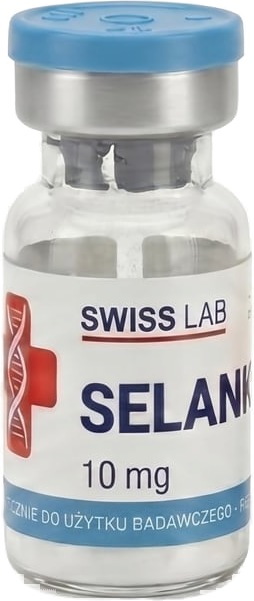
Selank is a synthetic peptide (a short chain of seven amino acids, the building blocks of proteins) developed at Russian research institutes as a candidate anti-anxiety agent. In animal and cell studies it has been analysed as a peptide acting on several brain systems: the systems responsible for calming and for mood, on the brain's nerve-nourishing protein (BDNF), on the body's own pain-easing molecules (enkephalins) and on immunity. The review below sets out what genuinely follows from reputable publications and points honestly to the limits of that evidence base — including its heavily Russian origin and very sparse independent confirmation.
What Selank is and where it comes from
Selank was designed by teams associated with the Russian Academy of Sciences and psychiatric institutes in Moscow. It was created as a more stable version of tuftsin — a natural short peptide affecting immunity, which is a fragment of a larger immune-system molecule (an antibody). In Russian publications Selank appears alongside the related peptide Semax (based on a hormone fragment) as part of the same current of research on short regulatory peptides. Readers interested in that second compound may like our separate piece on Semax.
Tuftsin and the structure of the molecule
The parent tuftsin is a still shorter peptide, known chiefly for its effect on immunity — stimulating the cells that engulf and destroy microbes. Tuftsin's problem as a research molecule is its short life: it is quickly broken down by enzymes. In Selank a fragment of three amino acids — proline, glycine and proline — was added to the end of the chain. According to the descriptions, that addition increases the molecule's resistance to peptide-degrading enzymes, which under experimental conditions means the peptide persists longer and acts more reproducibly. Selank also retains some of the immune properties “inherited” from tuftsin.
The action studied: calming and mood
In animal and cell studies Selank is analysed as a factor acting on several brain systems at once. In the system responsible for calming, an effect on a receptor important for damping arousal is described — although, unlike sedatives of the benzodiazepine group, Selank did not act at the same site as they do. In the mood system (serotonergic), Russian publications describe Selank's effect on serotonin metabolism in the rodent brain; one paper compared Selank and tuftsin in this respect. It must be stressed that these are data from tissues and animal models, not a confirmed mode of action in humans.
Reducing anxiety in animal models
The most frequently cited feature of Selank is the reduction of anxiety observed in behavioural tests in rodents. In one of the few papers published in a peer-reviewed English-language journal, Selank was shown to enhance the calming effect of diazepam (a typical sedative) in rats under chronic, unpredictable, mild stress. The authors described the combination of diazepam with Selank as the most effective at reducing anxious behaviour in that model. It is an important result, because it comes from outside the exclusively Russian-language circuit, but it still concerns animals, not people.
Effects on the body's pain-easing molecules and on immunity
A separate line of research concerns Selank's effect on enkephalins — natural molecules produced by the body that take part in regulating mood and the response to stress (they act rather like painkilling substances). A 2001 paper showed that Semax and Selank slow the enzymes that break down enkephalins in human blood serum, and do so more strongly the higher the dose. The interpretation is that slowing enkephalin breakdown may prolong their action. The second thread is the effect on immunity: Selank, as a relative of tuftsin, is described in the context of effects on immune-regulating molecules (one of the immune system's signalling molecules among them). One human paper described such effects in patients with anxiety disorders accompanied by exhaustion.
Effects on BDNF and brain plasticity
Selank has also been studied for its effect on BDNF (the brain's nourishing protein), which is linked to nerve-cell survival and to the plasticity of connections between them. In a study in living animals, intranasal administration of Selank was associated with an effect on BDNF production in the rat hippocampus (a brain region important for memory). There are also papers on the peptide's effect on learning and memory in animals and on depression-like symptoms in rodent models. Caution applies here too: changing the amount of one protein in an animal is not the same as a therapeutic effect in a human being.
Animal and human studies
Most of the available data come from animal and cell studies. On the human side, the paper most often cited describes the efficacy and action of Selank in treating generalised anxiety disorder and nervous exhaustion: in a comparative study of patients, Selank was set against a benzodiazepine sedative, and the authors described a similar reduction of anxiety along with an additional “anti-asthenic” effect and changes in enkephalin activity in the blood. These publications were part of the basis on which Selank obtained the status of a registered anxiolytic in Russia. It has to be noted, though, that these are studies in small numbers of people, rarely meeting today's standards for large, independent multi-centre trials.
Limits of the evidence base (Russian origin)
An honest assessment of Selank has to take several important qualifications into account. First, the overwhelming majority of the publications come from Russian institutes connected with the peptide's originators, and many appeared in Russian-language journals. Second, independent confirmation outside that circle is very sparse — there are few English-language, peer-reviewed experimental papers. Third, the human studies are small and methodologically modest compared with the requirements applied to medicines today. These factors do not invalidate the results, but they mean they should be treated as preliminary and in need of confirmation, not as established knowledge.
Form and stability
Selank available as research material most often comes as a dried peptide powder, which requires refrigerated storage and protection from moisture and light. Once dissolved, the solution remains stable only for a limited time. The added proline-glycine-proline fragment matters precisely for resistance to enzymatic breakdown, which is often highlighted when planning experiments. Storage conditions and the purity of the preparation are decisive for the reproducibility of results.
Summary
Selank is an interesting anti-anxiety peptide, well described structurally, derived from tuftsin. The animal and cell literature describes a coherent picture of action across several fields: effects on the calming and mood systems, on enkephalins, on BDNF and on immunity. At the same time the evidence base is heavily concentrated in one research circle, poorly confirmed independently and thin on large human trials. For those following the science of longevity and of peptides, Selank remains a fascinating object of research — provided the data are read with due caution.
Sources
- Kost N.V. et al. (2001). Semax and selank inhibit the enkephalin-degrading enzymes from human serum. Bioorg Khim, 27(3):180–183. PMID: 11443939
- Inozemtseva L.S. et al. (2008). Intranasal administration of the peptide Selank regulates BDNF expression in the rat hippocampus in vivo. Dokl Biol Sci, 421:241–243. PMID: 18841804
- Zozulia A.A. et al. (2008). Efficacy and possible mechanisms of action of a new peptide anxiolytic selank in the therapy of generalized anxiety disorders and neurasthenia. Zh Nevrol Psikhiatr Im S.S. Korsakova, 108(4):38–48. PMID: 18454096
- Uchakina O.N. et al. (2008). Immunomodulatory effects of selank in patients with anxiety-asthenic disorders. Zh Nevrol Psikhiatr Im S.S. Korsakova, 108(5):71–75. PMID: 18577961
- Semenova T.P. et al. (2009). Comparison of selank and tuftsin effects on serotonin metabolism. Eksp Klin Farmakol, 72(4):6–8. PMID: 19803361
- Kasian A. et al. (2017). Peptide Selank Enhances the Effect of Diazepam in Reducing Anxiety in Unpredictable Chronic Mild Stress Conditions in Rats. Behav Neurol, 2017:5091027. PMID: 28280289 (PMC5322660)
For in-vitro laboratory research only. It is not a human medicine and is not for treatment.