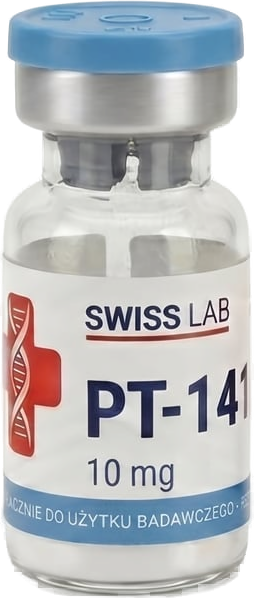
PT-141, also known as bremelanotide, is a laboratory-made peptide (a short chain of amino acids). One thing sets it apart from most “research” peptides: bremelanotide went through full human trials and in 2019 was approved by the US Food and Drug Administration (FDA) as a medicine called Vyleesi. That means that — unlike many substances described as “research reagents” — here there is hard data from proper human trials. This article sets out what is known about the molecule from the research and clearly separates the approved medicine from the “PT-141” sold as a research reagent.
What PT-141 / bremelanotide is
Bremelanotide is a small peptide created by reworking an older molecule — melanotan II. It acts on certain “switches” in the brain (receptors), mainly the one designated MC4R. Unlike melanotan II, which was first studied for skin tanning, bremelanotide was refined to act primarily on the brain centres responsible for sexual desire. If you are interested in the molecule it came from, see our piece on melanotan II.
The MC4R switch in the brain
The body has five “switches” in this family (designated MC1R–MC5R) responsible for different things — from skin colour to appetite. For bremelanotide's action the important one is MC4R, which is abundant in the parts of the brain responsible for motivation and desire. It is the activation of that switch that studies associate with an effect on sexual desire.
It acts in the brain, not on blood vessels
The most important difference concerns where and how the drug acts. Classic erection drugs (such as sildenafil, the well-known “blue pill”, or tadalafil) act on blood vessels: they increase blood flow. Bremelanotide works quite differently — in the brain, acting on the centres of desire rather than on vessels. That difference matters: it explains why the molecule was studied mainly in the context of reduced desire (rather than the mechanics of erection) and why its side effects (an effect on blood pressure, for instance) differ from those of vascular drugs.
History and the road to approval
Bremelanotide grew out of work on melanotan II carried out in the 1990s at the University of Arizona, where it was noticed that activating these switches produced effects beyond tanning. Development was taken over by Palatin Technologies, which in the early 2000s produced a refined version — PT-141. A nasal form was first studied in the context of erection in men, but a problem emerged: blood pressure rose. The programme therefore switched to a subcutaneous injection, which was better tolerated. After more than a decade of research the molecule was approved.
FDA approval — Vyleesi (2019)
On 21 June 2019 the US FDA approved bremelanotide under the name Vyleesi — as a subcutaneous injection given with a self-administered autoinjector. The drug was approved for one specific use: treating hypoactive sexual desire disorder (HSDD) in premenopausal women. It is worth stressing how narrow that indication is: it concerns a specific, diagnosed problem in a defined group, not a general “boost to libido”.
The clinical trials: the RECONNECT programme
The approval rested on two identically designed trials — proper, blinded (neither participants nor doctors knew who received the drug and who an inactive placebo injection), multi-centre studies — known together as the RECONNECT programme. The results were published in a peer-reviewed medical journal (Kingsberg et al., 2019). Together they enrolled 1,267 women with reduced desire lasting at least six months (average age about 39). The drug was given “as needed” and follow-up ran for 24 weeks. Two main things were assessed: the level of desire, and how much distress the low desire caused these women — both measured with dedicated questionnaires.
Efficacy — how to read the results
In both trials bremelanotide did better than placebo on both main measures: it improved desire and reduced the associated distress. These figures have to be read honestly, though: the effect was clear and reproduced in two independent trials, which is strong evidence, but its size was moderate and the results rested on subjective questionnaires. Even so, it is far stronger evidence than for most peptides known only from animal studies — here there is real human data.
Safety and contraindications
The side effects were described in detail both in the RECONNECT trials and in pooled analyses (Clayton et al., 2022) and in the official product information. The main ones:
- Nausea — the commonest side effect; in the pooled analysis about 40% of treated participants reported it (against about 1% on placebo). Usually mild and most often after the first dose.
- A transient rise in blood pressure and a brief slowing of the heart rate after injection — usually self-limiting, but the reason for restrictions on use.
- Facial flushing and headaches — common in both trials.
- Darker patches on the skin (hyperpigmentation) — related to the action on the switches described above, reported particularly with frequent use; a direct echo of the molecule's “ancestry” in melanotan II.
Because of the effect on blood pressure the drug is contraindicated in people with uncontrolled hypertension and with cardiovascular disease, and the number of doses in a given period is limited. These restrictions concern use of the medicine under a doctor's care, and we give them only to show the context.
A medicine versus a research reagent
Two things must be clearly separated. Vyleesi is a specific, FDA-approved medicine: a defined form (an autoinjector), a strictly set dose, an approved indication and oversight of quality and safety. “PT-141” sold as a research reagent, by contrast, is raw peptide for laboratory use — with no medicine status, no approved indication and no quality guarantee. The fact that the substance is the same does not turn a reagent into a medicine and does not license its use in humans.
Summary
Bremelanotide (PT-141) holds a unique place among peptides: it acts on the MC4R switch in the brain rather than on blood vessels, and its efficacy and safety were tested in proper human trials, after which it obtained FDA approval as Vyleesi for a narrowly defined indication. The evidence is real, reproducible and published — with a moderate effect size and clear side effects (nausea, a transient rise in blood pressure, pigmentation). At the same time, the existence of an approved medicine does not change the status of “PT-141” sold as a reagent, which remains material for laboratory research only.
Sources
- Kingsberg SA, Clayton AH, Portman D, et al. Bremelanotide for the Treatment of Hypoactive Sexual Desire Disorder: Two Randomized Phase 3 Trials. Obstet Gynecol. 2019;134(5):899–908. PMID: 31599840. PubMed
- Clayton AH, Kingsberg SA, Portman D, et al. Safety Profile of Bremelanotide Across the Clinical Development Program. J Womens Health (Larchmt). 2022;31(2):171–182. PubMed
- U.S. Food and Drug Administration. VYLEESI (bremelanotide injection) — Full Prescribing Information / Drug Approval Package. 2019. accessdata.fda.gov
- ClinicalTrials.gov. Study to Evaluate the Efficacy/Safety of Bremelanotide in Premenopausal Women With HSDD (RECONNECT). NCT02333071. ClinicalTrials.gov
For in-vitro laboratory research only. It is not a human medicine and is not for treatment.