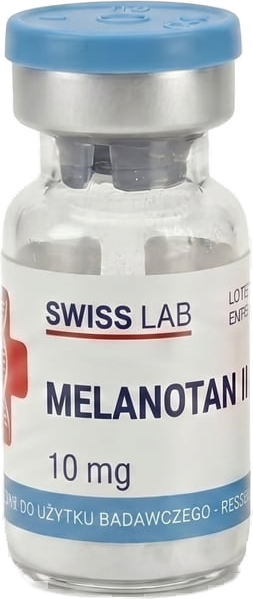
Melanotan II (MT-II for short) is a laboratory-made molecule similar to the natural hormone that controls skin colour (called alpha-MSH). It was created as a research tool and is associated mainly with darkening of the skin (tanning without sun) and with effects on sexual function. It is not an approved medicine, and in many countries selling it for human use is illegal. The text below is informational and scientific only, and summarises what is known about the substance — including the documented risks.
What Melanotan II is
Melanotan II is a small peptide (a short chain of amino acids) built to be more stable and more potent than the natural hormone it is modelled on. It must be distinguished from Melanotan I (afamelanotide, the medicine Scenesse), which went through full trials and was approved for treating a rare disease. Melanotan II, by contrast, is a substance without a licence and largely untested in humans. Outside legal channels it is most often sold as a powder for the buyer to dissolve and inject under the skin.
Where it comes from: the University of Arizona research
Work on molecules of this kind began in the 1980s at the University of Arizona in the team of Victor Hruby and Mac Hadley. After screening hundreds of compounds they described a peptide about a thousand times more potent than the natural hormone and called it “Melanotan” (later Melanotan I). Melanotan II came about as a further version, in the search for “safe tanning” without exposing the skin to the sun. The same work also gave rise to bremelanotide — a molecule studied for effects on sexual function, which went its own research way.
The receptors it acts on (MC1R–MC5R)
The body has five “switches” responding to hormones of this family, designated MC1R, MC2R, MC3R, MC4R and MC5R. Each is responsible for something different:
- MC1R — in skin cells; it determines pigment production and skin colour.
- MC2R — in the adrenal glands; linked to production of the stress hormone (cortisol).
- MC3R and MC4R — in the brain; they affect appetite, energy balance and sexual function.
- MC5R — in glands among other places; its role is still being studied.
Melanotan II acts on several of these switches at once — not only the one governing skin colour. That is precisely why tanning comes with a whole series of side effects originating in the brain.
How it darkens the skin
Activating the MC1R switch in skin cells sets off production of the dark pigment (melanin) that partly shields skin from the sun. In studies the skin darkened after only a few doses, and Melanotan II also amplified the skin's response to sunlight (UV). It must be stressed, though: such an artificial tan does not fully protect against sun damage and does not remove the risk associated with UV radiation.
How it affects sexual function
Activating the MC4R switch in the brain is associated with sexual effects, including erections independent of stimulation. In an early study in healthy volunteers, spontaneous erections were one of the effects noted, alongside nausea and drowsiness. On that basis a separate molecule was developed — bremelanotide — studied in sexual dysfunction. Melanotan II itself, however, is not approved for any use, and its action on the brain is at the same time the source of the side effects (nausea, loss of appetite, prolonged erections).
What has been studied
There is very little human data, and it comes mainly from small early trials. The first study, published in 1996, involved just three healthy volunteers receiving injections every other day. A more pronounced tan was observed alongside mild side effects (nausea, drowsiness) and spontaneous erections. Most later knowledge about safety comes not from proper trials but from individual case reports in people using preparations from illicit supply. The evidence is therefore scant and weak.
Known risks and safety
This is the most important part of this text. Melanotan II is associated with real, documented risks:
- Changes in moles and melanoma risk. Darkening and enlargement of existing moles, the appearance of new ones and of abnormal-looking ones have been described. The medical literature reports cases of eruptive moles after injections (Cousen et al., British Journal of Dermatology, 2009) and cases of melanoma (a dangerous skin cancer) associated with use of the substance. Some authors believe it may not so much cause melanoma as accelerate the development of existing lesions; others point out that the excess of cases may follow from intensive tanning (sunbeds, sun). Whatever the explanation — any change in the appearance, colour or size of a mole requires assessment by a dermatologist.
- Priapism and prolonged erections. Erections lasting one to five hours were described as a common effect. A painful, prolonged erection (priapism) is an emergency requiring urgent medical help, as it risks permanent tissue damage.
- Nausea, vomiting, loss of appetite, facial flushing, drowsiness, yawning — typical, frequent symptoms following from activation of several switches at once.
- Rarer, serious events. Case reports have described muscle-tissue breakdown (with dark urine), nail pigmentation, and symptoms involving the brain and nervous system.
- No quality control in illicit supply. Products bought outside legal channels have no verified composition, purity or sterility. There is a real risk of contamination and of incorrect content of the substance, and with self-injection, of infection.
Regulations and warnings
Melanotan II is not approved for any medical use and is not legal to sell to people in any country. Warnings have been issued by the US FDA, the British MHRA and the Australian TGA, among others. The regulators agree that Melanotan II is an untested and potentially dangerous substance, not a “safe alternative” to tanning.
Summary
Melanotan II is an interesting tool for studying how the switches described above work, and it shows that activating all of them at once affects skin colour, appetite and sexual function simultaneously. Scientifically, though, what matters most is an honest balance: the human studies are few and early, most safety knowledge comes from individual cases, and the signals about moles, melanoma and priapism are serious. Add to that the absence of quality control in illicit supply and unambiguous regulatory warnings. This is not an approved medicine, and the supposed cosmetic benefits do not outweigh the real risks. Any change in the skin, especially a change in a mole, should be assessed by a doctor.
Sources
- Dorr RT et al. Evaluation of melanotan-II, a superpotent cyclic melanotropic peptide in a pilot phase-I clinical study. Life Sciences, 1996 (PMID: 8637402)
- Cousen P et al. Eruptive melanocytic naevi following melanotan injection. British Journal of Dermatology, 2009
- Melanotan-associated melanoma. British Journal of Dermatology, 2011 (case report)
- Böhm M et al. An overview of benefits and risks of chronic melanocortin-1 receptor activation. Journal of the European Academy of Dermatology and Venereology (JEADV), 2025
- Melanotan II — DermNet (dermatology reference)
- University of Arizona Cancer Center — the history of the melanotropin analogue discovery (Hruby, Hadley, Dorr)
- Cancer Research UK — fake tan and Melanotan injections (warnings and risks)
For in-vitro laboratory research only. It is not a human medicine and is not for treatment.