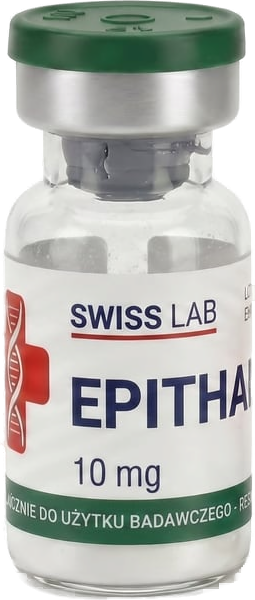
Epitalon (also written Epithalon or Epithalone) is a peptide — a short chain of four amino acids, the chemical “building blocks” that proteins are made from. It is made synthetically in the laboratory. It is one of the most talked-about compounds among people interested in slowing ageing, mainly because of reports that it may affect telomerase and the sleep hormone melatonin. It is also a good example of how carefully scientific research has to be read — because almost all the data come from one centre and nobody independent has replicated them. In this article we gather what is genuinely known, and say just as honestly what is not known.
What Epitalon is and where it comes from
Epitalon comes out of the Russian (formerly Soviet) school of research on short peptides. The work was begun in the early 1970s by the team of Vladimir Khavinson and Vladimir Anisimov in St Petersburg. The starting point was epithalamin — an extract of the pineal gland (a small gland in the brain) obtained from cattle. It was a mixed set of peptides credited with the ability to slow ageing. Epitalon was meant to reproduce, in a single simple molecule, whatever was responsible for the extract's action.
One thing is worth noting straight away: the body of work on Epitalon runs to over a hundred publications, but a large share appeared only in Russian and nobody independent has checked them. That matters when judging how far they can be trusted.
The idea of “tuning” the pineal gland
The Khavinson school rests on the idea that short peptides can act as signals regulating gene activity in particular organs and “restoring” to ageing tissue the mode of operation typical of a young body. The pineal gland is treated here as an internal clock, and Epitalon as the compound that “tunes” it.
It has to be stressed, though, that this is a theory created and developed largely by one team. The idea that short peptides can influence gene activity is conceivable, but the specific mechanisms proposed for Epitalon have not been unambiguously confirmed and remain, for now, hypotheses.
The structure of the molecule
Epitalon consists of four amino acids joined in a chain. It is a very small molecule, which raises a practical problem scientists write about: peptides this short usually break down quickly in the body. Interestingly, in 2017 a peptide of the same composition was described as occurring naturally in the pineal gland. Despite many years of research into its action, there is surprisingly little work on Epitalon's chemistry itself.
Telomerase and telomeres
The most talked-about thread concerns telomerase. To explain: the ends of our chromosomes have protective “caps” called telomeres, which shorten with every cell division — rather like the wearing tip of a shoelace. Telomerase is the enzyme that can rebuild those caps. In studies on human cells in a dish, Khavinson's team reported that adding Epitalon switched on telomerase activity and lengthened telomeres in cells that normally do not do this.
In a further paper the same team reported that with Epitalon, ageing cells passed the natural limit on the number of divisions (the Hayflick limit) and performed about 10 extra divisions. These are very strong claims — and precisely for that reason they require independent confirmation, which is so far lacking.
Melatonin and hormonal regulation
The second main thread is the effect on melatonin, the sleep hormone. In studies in old monkeys and in older people, pineal peptides were said to “restore” nocturnal melatonin secretion and tidy up its daily rhythm. The literature also credits Epitalon with cell-protective action and an effect on certain immune-system molecules. These observations are scattered, however, come from small groups and — like the rest of the data — from a single research community.
Animal studies
Some of the animal work is reasonably thorough. In one experiment in mice, monthly administration of Epitalon did not extend average lifespan and did not change body weight or the overall number of tumours, but several effects were described: slower decline of reproductive capacity, less damage in bone-marrow cells and strong suppression of leukaemia development.
One detail often lost in popular accounts is worth noting: in that particular experiment Epitalon did not extend average lifespan. The effects concerned only selected parameters. It is a good example of why slogans such as “the life-extension peptide” tend to overreach.
Human studies and their weaknesses
The “human” data concern mainly the extract (epithalamin) rather than pure Epitalon, and come largely from older Russian work. It cites observations in people over 60 in whom years of pineal-peptide administration were said to be associated with lower mortality. The problem is that these studies were usually not blinded (arranged so that neither the participants nor the investigators knew who received the compound), reported their results differently, and nobody independent has repeated them. In practice this means there are no large, independent, well-designed trials confirming the key claims about Epitalon in humans.
A critical look at the evidence
Taken together, the evidence for Epitalon has several serious weaknesses that should be stated plainly:
- A single centre. Almost all the key papers come from the Khavinson and Anisimov laboratory. The lack of independent replication is not a detail — it is a fundamental credibility problem.
- Small groups, and mostly animals and dishes. The strongest claims rest on cells in a dish and on animals, not on solid human trials.
- A language barrier. A large share of the work is in Russian and reports results in an unusual way, which makes verification harder.
- Gaps in the safety data. More recent reviews note that full data on whether the compound is safe in the short and long term are missing.
- An unclear mechanism. Despite many years of publication, it is still not exactly known how Epitalon is supposed to work.
In other words: an interesting scientific hypothesis is not the same as a proven effect. Epitalon is an excellent subject for discussion and further study, but current knowledge does not allow it to be treated as an established agent.
Research status
Epitalon is not a medicine approved for sale in the European Union. It circulates solely as a laboratory research reagent (“research use only”). All the information in this article is for knowledge alone and serves the exchange of information among people curious about the biology of ageing — it is not guidance on use in humans. We give no methods of use and no doses.
Summary
Epitalon is a synthetic four-amino-acid peptide modelled on a pineal extract. It became a star of longevity conversations thanks to reports of switching on telomerase, lengthening telomeres and affecting melatonin. Those mechanisms sound interesting, but the actual evidence is weak: it comes mainly from dishes and animals, from one centre, and nobody independent has replicated it in a large group of people. It is a compound for those curious about science and aware of its limits — with a clear distinction between what has been preliminarily tested and what has genuinely been proven.
Sources
- Araj SK, Brzezik J, Mądra-Gackowska K, Szeleszczuk Ł. Overview of Epitalon—Highly Bioactive Pineal Tetrapeptide with Promising Properties. Int J Mol Sci. 2025;26(6):2691.
- Khavinson VKh, Bondarev IE, Butyugov AA. Epithalon peptide induces telomerase activity and telomere elongation in human somatic cells. Bull Exp Biol Med. 2003;135(6):590–592.
- Khavinson VKh, Bondarev IE, Butyugov AA, Smirnova TD. Peptide promotes overcoming of the division limit in human somatic cell. Bull Exp Biol Med. 2004;137(5):503–506.
- Anisimov VN, Khavinson VKh, et al. Effect of Epitalon on biomarkers of aging, life span and spontaneous tumor incidence in female Swiss-derived SHR mice. Biogerontology. 2003;4(4):193–202.
- Korkushko OV, Lapin BA, Goncharova ND, Khavinson VKh, et al. Normalizing effect of the pineal gland peptides on the daily melatonin rhythm in old monkeys and elderly people. Adv Gerontol. 2007;20(1):74–85.
For in-vitro laboratory research only. It is not a human medicine and is not for treatment.